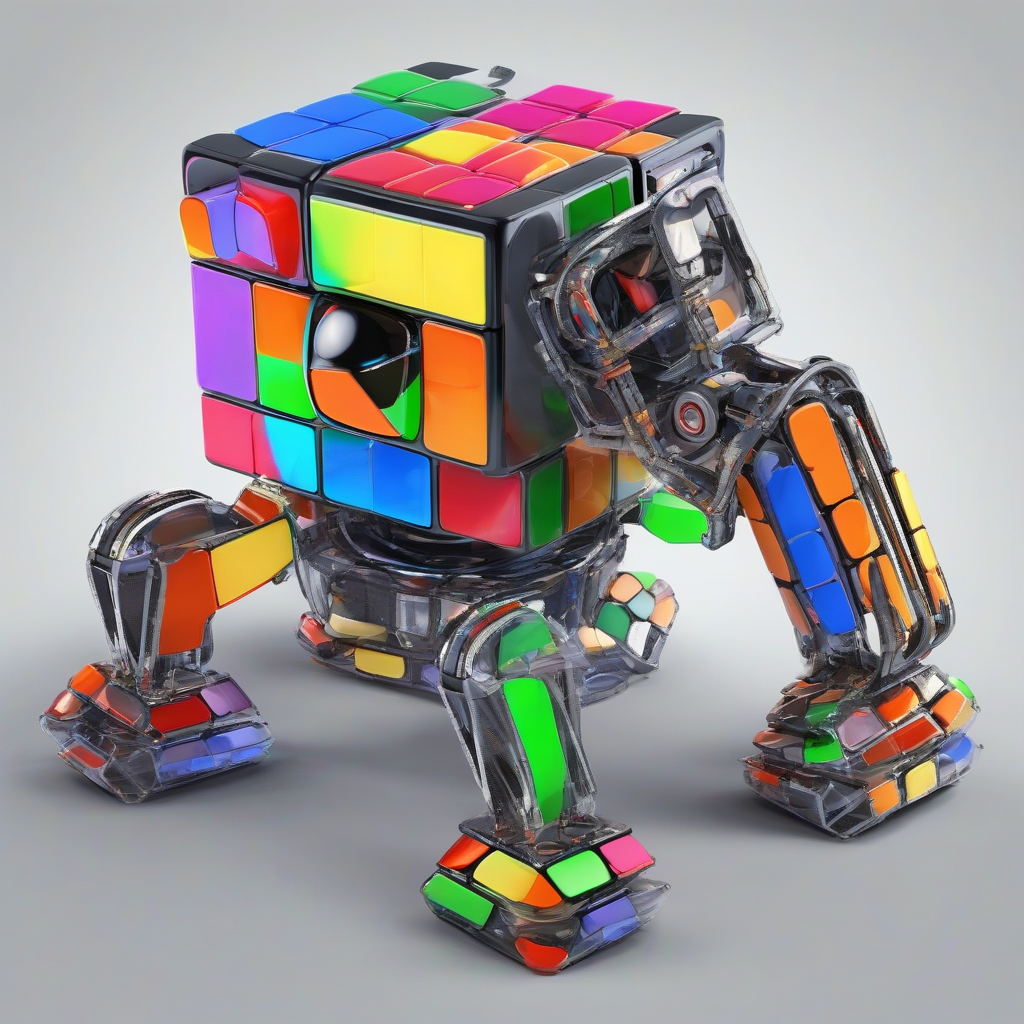
Video Friday: Quadruped Robot Solves Giant Rubik’s Cube by Itself
Video Friday is your weekly selection of awesome robotics videos, collected by your friends at IEEE Spectrum robotics. We also post a weekly calendar of upcoming robotics events for the next few months. Please send us your events for inclusion.CoRL 2026: 9–12 November 2026, AUSTINHumanoids 2026: 6–9 December 2026, SANTA CLARA, CAEnjoy today’s videos! A quadruped robot autonomously solves a giant Rubik’s Cube using only its feet.[ ETH Zurich Robotics Systems Lab ]Humans effortlessly react to the world; they adeptly return a tennis shot, catch a falling cup, step aside from a passing cart, or pass a box tossed during truck unloading. These everyday actions require anticipating a moving target and reflexively responding with the whole body within about a second. Such visual reactive whole-body control remains challenging for humanoids. We present Reflex, a three-stage framework that learns these capabilities stage by stage while connecting them through a compact representation of object dynamics.[ Reflex ]Thanks, Weikai!I have long advocated for exactly this in the context of robotic laundry folding, or more broadly, other robot recognition and manipulation tasks. Why not make it easy when we can make it easy?[ ACM SIGCHI ]We first wrote about Parallel Systems in 2022. Nice to see them still rolling.[ Parallel Systems ]I’ll be honest with you: The end of this video is freaking me out a little bit for some reason.This video showcases the whole-body loco-manipulation capabilities of KAIST Humanoid v0.9, developed at the DRCD Lab in collaboration with RAILAB, which developed the robot’s arms. Using onboard visual feedback, the humanoid demonstrates pushing objects weighing up to 35 kilograms and lifting objects up to 20 kg to arrange the letters “KAIST.”[ KAIST DRCD Lab ]When you don’t spend any money on sensors for your robots, you can afford much bigger wheels.[ RaiLab Kaist ]Those robots with wires have gotten somewhat weirder.[ JSK Robotics Laboratory ]The AthenaZero has two, three-fingered robot hands driven by tendons. This design allows the fingers to interdigitate to hold objects of different sizes, such as an egg or a hammer. Each finger is powered by a motor located in the robot’s torso to keep the hand light, transmitting force through flexible cables. This hand is both fast (closing in about 80 milliseconds) and strong. With the addition of highly accurate barometric pressure sensors, it can also be gentle.[ Robotics and AI Institute ] via [ Science Robotics ]A biohybrid robot combines living tissue with engineered materials—here, lab-grown skeletal muscle paired with a soft, 3D-printed scaffold that turns the muscle’s contraction into movement. What if you designed the living muscle and the soft scaffold together, instead of growing the muscle and then building a skeleton around it? In this work from the Soft Robotics Lab at ETH Zurich, we adapted a soft-body simulation framework to co-optimize both at once—and the resulting centimeter-scale bioactuators achieve up to 11x more range of motion than previous systems of comparable tissue volume. Strong enough to jump, swim, walk, and grasp.[ ETH Zurich Soft Robotics Lab ]Oh yes, this is definitely the use case that will scale humanoid robots.[ Unitree ]Here are a couple more teasers from the upcoming ACM Symposium on User Interface Software and Technology (UIST). [ ACM Symposium on User Interface Software and Technology ]In three hours, on a single GPU, SuperMimic surpasses the return of a state-of-the-art motion tracker baseline trained for seven days on 128 GPUs. It reduces GPU-hours by more than 1,000× and fails on only 25 of 129,514 benchmark motions, versus 179 failures for the baseline. After 9.8 hours on two GPUs, SuperMimic achieves zero failures.[ Hybrid Robotics ]This is getting out of hand! Now there are two of them!Introducing the Grain Weevil dual robot attachment. Two robots linked into one larger machine, run by a single operator, doing the work of up to three robots.[ Grain Weevil ]Today [21 October 2026] at CES Unveiled Milan, Generative Bionics announced its plan to build Europe’s largest Physical AI Data Factory, with AMD as its AI infrastructure partner.[ Generative Bionics ]From robotic rovers exploring the rugged lunar landscape to lunar terrain vehicles carrying Artemis astronauts across the surface, mobility will play a crucial role in establishing an enduring human presence on the moon. During the early phases of Moon Base development, these vehicles will help NASA investigate the lunar South Pole region, conduct scientific research, test new technologies, and gather the information that will inform future missions. In this Moon Base update, get a closer look at some of the lunar terrain vehicles and robotic rovers helping to pave the way for humanity’s first lunar outpost. [ NASA ]I appreciate the designer of this single motor drone crediting previous research, which included some cool drones from UPenn that we wrote about in 2014.[ Joshua Bird ]Why choose a bipedal, human-form robot over specialized wheels, gantry arms, or quadruped platforms? Speaking at the Humanoids Summit Seoul 2026, Michael Perry from Persona AI tackles the single most debated question in the industry and delivers the definitive business and engineering justification for the humanoid form factor.[ Humanoids Summit ]]]>
Source: https://spectrum.ieee.org/video-friday-rubiks-cube-robot