Q&A: Mars Perseverance Rover Sets a Distance Record
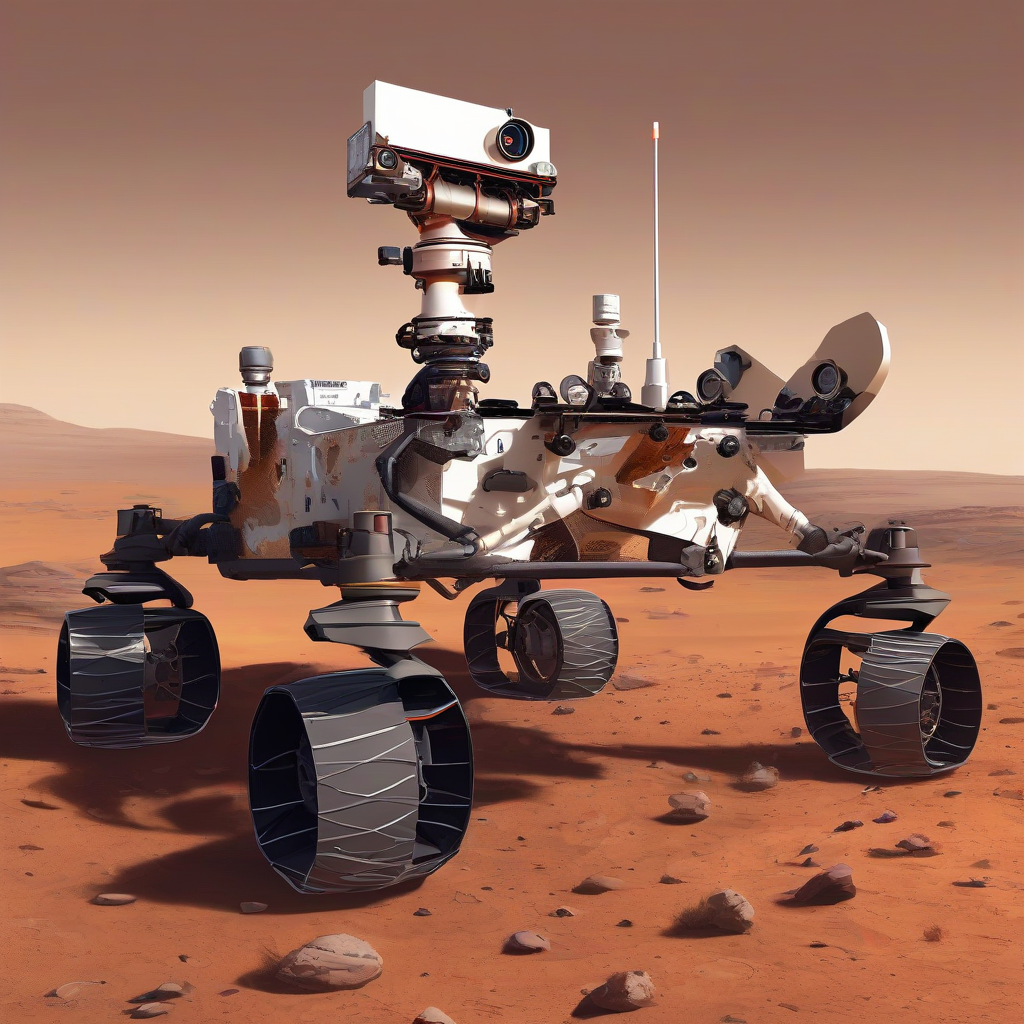
On 11 October, the Perseverance rover completed a drive that brought its total distance traveled on Mars to 28.10 miles (45.22 kilometers). This is a new record for Mars rovers, enabled in large part by Perseverance’s ability to drive with much more autonomy than its predecessors. Over the past five years, Perseverance’s autonomy software has been steadily upgraded, and to learn more about how the record was broken and what the future holds for the rover, we spoke with Mark Maimone, the Perseverance Robotic Operations Deputy Team Chief at NASA’s Jet Propulsion Laboratory, who designed and developed the self-driving software for Mars rovers Spirit, Opportunity, Curiosity, and Perseverance.Before we talk about Perseverance, let’s pour one out for the previous record holder, Opportunity, which landed on Mars in January 2004 for a three-month mission and ended its epic journey 15 years later in February 2019. This NASA video compresses Opportunity’s entire mission into four minutes and gives a poignant sense of the incredible distance that this little rover traveled over its 15-year life on Mars, doing science as it went: NASA Jet Propulsion Laboratory/YouTube Opportunity drove 45.16 kilometers until a planetary-scale dust storm stopped it in its tracks, appropriately enough, in Perseverance Valley.On 18 February 2021, Perseverance joined NASA’s Curiosity rover on the red planet, carrying the Ingenuity helicopter tucked under its belly. Curiosity and Perseverance both ditched Opportunity’s solar panels for a radioisotope thermoelectric generator. Curiosity has been active on Mars since 2012.Despite Curiosity’s nearly 10-year head start, Perseverance is the rover to first break Opportunity’s record. There are several reasons for Perseverance overtaking Opportunity—ruggedized wheels for one—but the biggest contributor is that Perseverance was built for autonomy. Maimone shares how JPL added enough autonomy for its Mars rover to drive itself from 225 million km away without crashing. This animation shows Perseverance’s point of view during a drive of 807 feet (246 meters) along the rim of Jezero Crater on 10 December 2025, the 1,709th Martian day, or sol, of the mission. Captured over 2 hours and 35 minutes, 53 Navigation Camera (Navcam) image pairs were combined with rover data on orientation, wheel speed, and steering angle, as well as data from Perseverance’s Inertial Measurement Unit, and placed into a 3D virtual environment. The result is this reconstruction with virtual frames inserted about every 4 inches (0.1 meters) of drive progress. JPL-Caltech/NASA Let’s talk about rover autonomy on Mars. Even before Perseverance, rovers were driving themselves, right?Mark Maimone: Yes! Sojourner [in 1997] had an early kind of autonomous behavior—for sensing, it used four laser stripes projected onto the surface, which it used to measure the height of 20 points in the terrain in front of it. It could steer around big obstacles, or even thread the needle between two things. It was a real autonomy system, which is very impressive considering its CPU was less than one megahertz. With Spirit and Opportunity, I developed the autonomy for those rovers. Every time they drove, they would use 256 x 256 pixel stereo pairs to map the geometry of the terrain and find a safe route forward. Spirit actually ended up driving itself 23 percent of the time, which I was frankly shocked by, since it drove much more slowly in that mode. But using autonomy helped Spirit travel 50 percent faster than it otherwise could have. Opportunity and Curiosity both only used autonomous driving about 5 percent of the time. Perseverance is the first Mars rover that drives itself 90 percent of the time, with its enhanced autonomy system that includes a second processor with an FPGA to speed up extra image processing operations.What was it like to let Perseverance drive itself for the first time?Maimone: Perseverance is the culmination of decades of work on Mars rover autonomy, so seeing Perseverance use its AutoNav system to drive itself basically at full speed, up to 120 meters an hour, was incredible. These two images taken by Perseverance’s hazard avoidance and navigation cameras show (at left) the very first AutoNav drive on Mars where the rover autonomously stopped before running into a rock pile, and (at right) the second AutoNav drive where the rover successfully steered around a rock.JPL-Caltech/NASAWhere are the humans in this process?Maimone: The plan of where to go is specified by the science team, and then on the engineering side, the strategic route planning team develops a path to get us to that goal by guessing, based on lower-resolution maps from orbit, what the terrain is going to look like for the rover. Each day, a tactical operations team combines the strategic overall route with that day’s science goals to pick the actual route the rover will follow.We want humans to keep doing long-range planning because that avoids wasting time. For example, we’ve learned that if we see sandy areas with intersecting waves or crests—not just ripples blown in one direction, but cross-ripples going in multiple directions—the rover tends to sink into terrain like that, so we tell the rover to keep out of those areas. The onboard autonomy only measures terrain shape, not terrain type, so it benefits from those location-based annotations.We now have years of experience correlating images taken from orbit with images taken by the rover, and understanding how different kinds of terrain affect the drive. With the current orbiters at Mars, we sometimes get 25 centimeters resolution on orbital images. That’s still not quite enough to see all obstacles; there could be a big rock that doesn’t really show up on a scale of more than one or two pixels, making it very hard to notice. That is why you want to have autonomy on the rover, but the greater help we can give it at a high level, the faster we can reach our goals and the fewer potential delays we’ll encounter. This orbital view shows a region of complex Martian terrain that Perseverance could not navigate autonomously. The blue line shows the path that human planners estimated, while the white line shows the path taken by the rover. The inset image, from Perseverance’s hazard avoidance camera, shows the rocky, sandy, and sloped terrain.Source images: Olivier Toupet, Masahiro Ono, et al.; JPL-Caltech/University of Arizona/NASA What happens when the autonomy system on Perseverance fails?Maimone: We ended up not using the autonomy at all for about two months in more complex terrain while we tuned things and wrote new software to deal with that new terrain we hadn’t encountered before. Some of those changes were relatively quick, and some required months of study. For example, one parameter is the maximum amount of slope that the robot is allowed to climb, because on steep slopes, there is a risk of the rover slipping sideways. We landed inside Jezero Crater, which was very flat, and so for the first three years, most of our driving was at less than 14 degrees of slope. When we finally decided to leave the crater, we began to encounter other terrain at higher tilts with greater rock density, and the experience we gained allowed us to re-tune the parameters to allow the rover to traverse those more difficult terrains, with slopes of up to 24 degrees.Rover autonomy in the age of AILate last year, you let Anthropic’s Claude AI plan a 400-meter drive for Perseverance. How did that go?Maimone: We had the AI look at the orbital images and pick out a path for us, which became the starting point of the day’s rover planning operations. Typically, that starting path comes from the human rover planner team, but in this case, it was generated by AI. Humans were still in the loop; the team reviewed it and made a couple of adjustments. AI gave us a solid starting point that allowed us to make rapid progress, because it’s much easier to validate a path than to pick one from scratch. NASA’s Perseverance Mars rover took this selfie on July 23, 2024. The selfie is composed of 62 images taken by the WATSON (Wide Angle Topographic Sensor for Operations and eNgineering) camera on the end of the rover’s robotic arm.JPL-Caltech/MSSS/NASADo you think humans will remain a necessary part of rover operations, or do you see the next generation of Mars rovers operating for weeks at a time without human assistance?Maimone: One of the things that has held us back from driving very long distances autonomously is that as we drive, the rover accumulates uncertainty in its position. When the uncertainty grows, it means we have to stay farther away from areas that human rover planners have identified as being potentially dangerous, called “keep-out zones.” In some cases, the uncertainty gets high enough that the rover can’t plan a safe path, because the keep-out zones (which grow with the rover’s uncertainty) get too big.We now have a new capability that we’ve added to Perseverance called Mars Global Localization. With this new technology that can shrink our uncertainty, we theoretically have the ability to go as long as we have resources to keep driving safely based on our maps and keep-out zones.But to truly run a mission for weeks, you need to not only drive long distances, but also execute science operations autonomously. We have people here also looking at automating science operations by doing image processing onboard the rover to get a better understanding of what’s out there and where to focus the instruments’ attention. So I do think we are getting to the point where we can support long-period autonomous operations. It has been a slow evolution, but we have great capabilities now and a good understanding of what’s needed to make it work well.As someone who has been involved with all of these Mars rovers—including one that got stuck—do you fundamentally trust Perseverance to operate autonomously?Maimone: I do. We built the software, tested it, ran millions of simulations, and did lots of work in the field in many different test environments. It hasn’t steered us wrong yet. We’re looking forward to setting even bigger records.]]>
Source: https://spectrum.ieee.org/mars-rover-distance-record