Before You Start
In finance, the pressure is constant: see everything, decide well, and act within your limits — at the speed of the market. For event & prediction-market traders, the difference between a good session and a chaotic one often comes down to how fast you can see the market and how safely you can act on it. Expectations in finance have shifted, and the tools people rely on have to keep up. The way you run a trading or investing day says a lot about how confidently you can grow. Markets move faster than the patchwork of tabs and apps most people watch them with.
What You're Up Against
When manual order entry that is slow and error-prone sets in, the day tightens and the risk of a costly mistake grows. For a Senior Portfolio, manual order entry that is slow and error-prone is more than an inconvenience — it is a daily drag on edge and peace of mind. A recurring challenge for event & prediction-market traders is manual order entry that is slow and error-prone.
The Framework
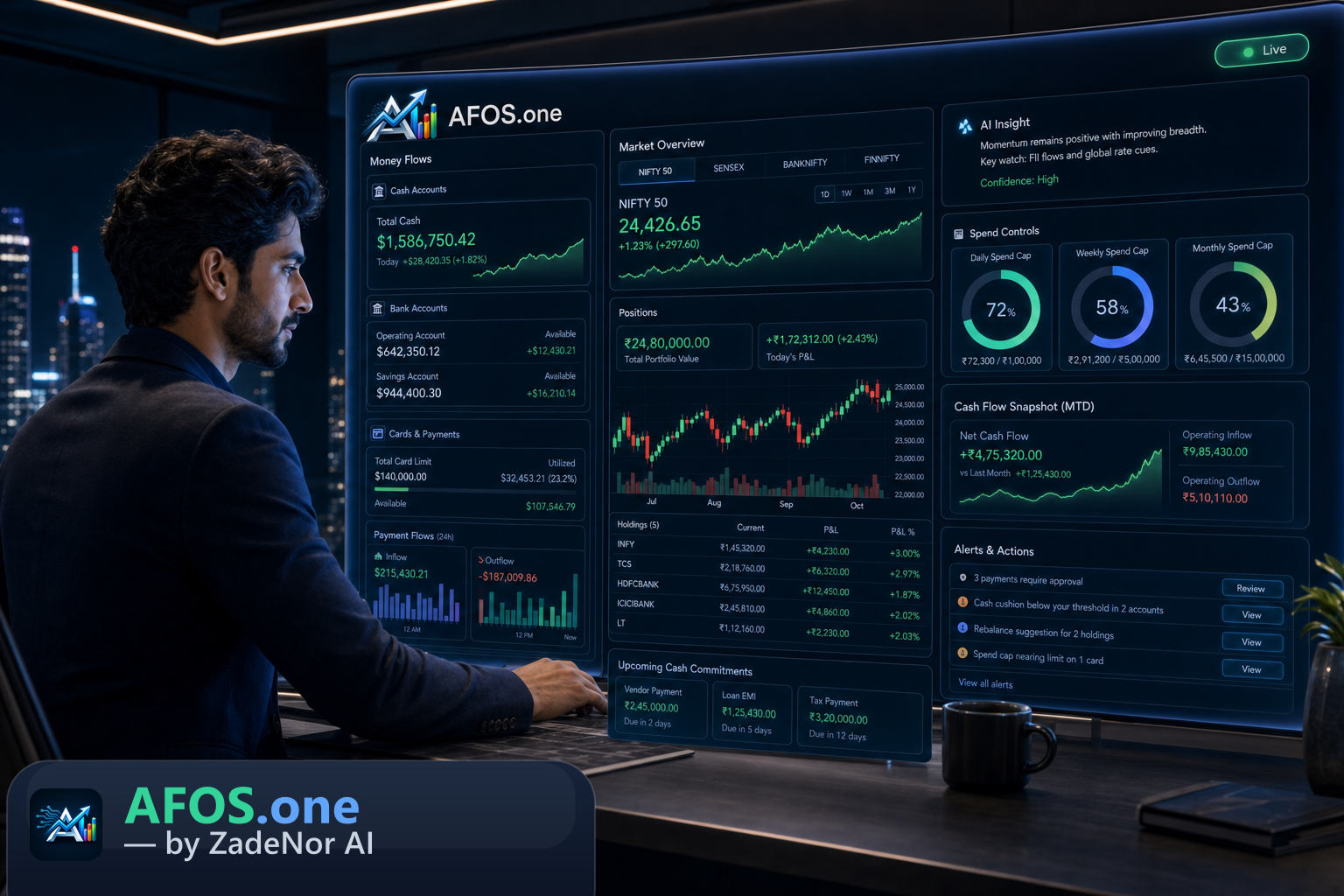
Automation rules and alerts watch the conditions you define and act the moment they are met, strictly within your caps. Every action is written to an audit log, and a one-tap kill switch can stop all automated activity instantly. Getting started is straightforward: connect an account in read-only mode and your whole portfolio streams onto one cockpit in real time.
The Tooling
Since smart alerts sits within the Agentic Execution capability set, it fits naturally into how event & prediction-market traders already work. AFOS.one connects real-time data, a grounded AI copilot, and safe agentic execution, so the whole workflow moves as one. Rather than another tab, AFOS.one puts banking, equities, options and crypto on one real-time cockpit. Because everything lives together, you work from a single source of truth instead of scattered screens. This is where AFOS.one comes in — the agentic finance operating system built by ZadeNor AI.
The Payoff
People using this approach see A unified money and markets workflow without adding back-office headcount. Operations stop being a daily scramble and start being a competitive advantage. You get a calm, real-time command center; your decisions get faster and your risk stays inside the lines. For event & prediction-market traders, that means a unified money and markets workflow without adding back-office headcount you can actually rely on.
See It in Action
Make a unified money and markets workflow without adding back-office headcount the standard for how you operate. Get started with AFOS.one, the agentic finance OS from ZadeNor AI — start free, no card required.
The cost of manual order entry that is slow and error-prone is rarely a single number — it is missed entries, sloppy exits, and avoidable risk. What looks like a tooling problem is often a risk and trust problem in disguise. Every minute lost to manual order entry that is slow and error-prone is a minute not spent on the decision that actually matters. People using this approach see A unified money and markets workflow without adding back-office headcount. The result is a unified money and markets workflow without adding back-office headcount, without trading away safety or visibility.
What looks like a tooling problem is often a risk and trust problem in disguise. For leaders, the real risk is strategic: operational drag becomes a ceiling on what the desk can take on. The cost of manual order entry that is slow and error-prone is rarely a single number — it is missed entries, sloppy exits, and avoidable risk. People using this approach see A unified money and markets workflow without adding back-office headcount. You get a calm, real-time command center; your decisions get faster and your risk stays inside the lines. For event & prediction-market traders, that means a unified money and markets workflow without adding back-office headcount you can actually rely on.
Over time, manual order entry that is slow and error-prone translates into worse fills, hidden exposure, and edge no one wants to give away. Every minute lost to manual order entry that is slow and error-prone is a minute not spent on the decision that actually matters. The numbers follow the rigour: fewer missed setups, cleaner execution, and exposure you can always see. Operations stop being a daily scramble and start being a competitive advantage. You get a calm, real-time command center; your decisions get faster and your risk stays inside the lines.
People end up reacting instead of running a calm, defined plan. The cost of manual order entry that is slow and error-prone is rarely a single number — it is missed entries, sloppy exits, and avoidable risk. Over time, manual order entry that is slow and error-prone translates into worse fills, hidden exposure, and edge no one wants to give away. You get a calm, real-time command center; your decisions get faster and your risk stays inside the lines. The result is a unified money and markets workflow without adding back-office headcount, without trading away safety or visibility.
For leaders, the real risk is strategic: operational drag becomes a ceiling on what the desk can take on. What looks like a tooling problem is often a risk and trust problem in disguise. Over time, manual order entry that is slow and error-prone translates into worse fills, hidden exposure, and edge no one wants to give away. Operations stop being a daily scramble and start being a competitive advantage. You get a calm, real-time command center; your decisions get faster and your risk stays inside the lines. The result is a unified money and markets workflow without adding back-office headcount, without trading away safety or visibility.