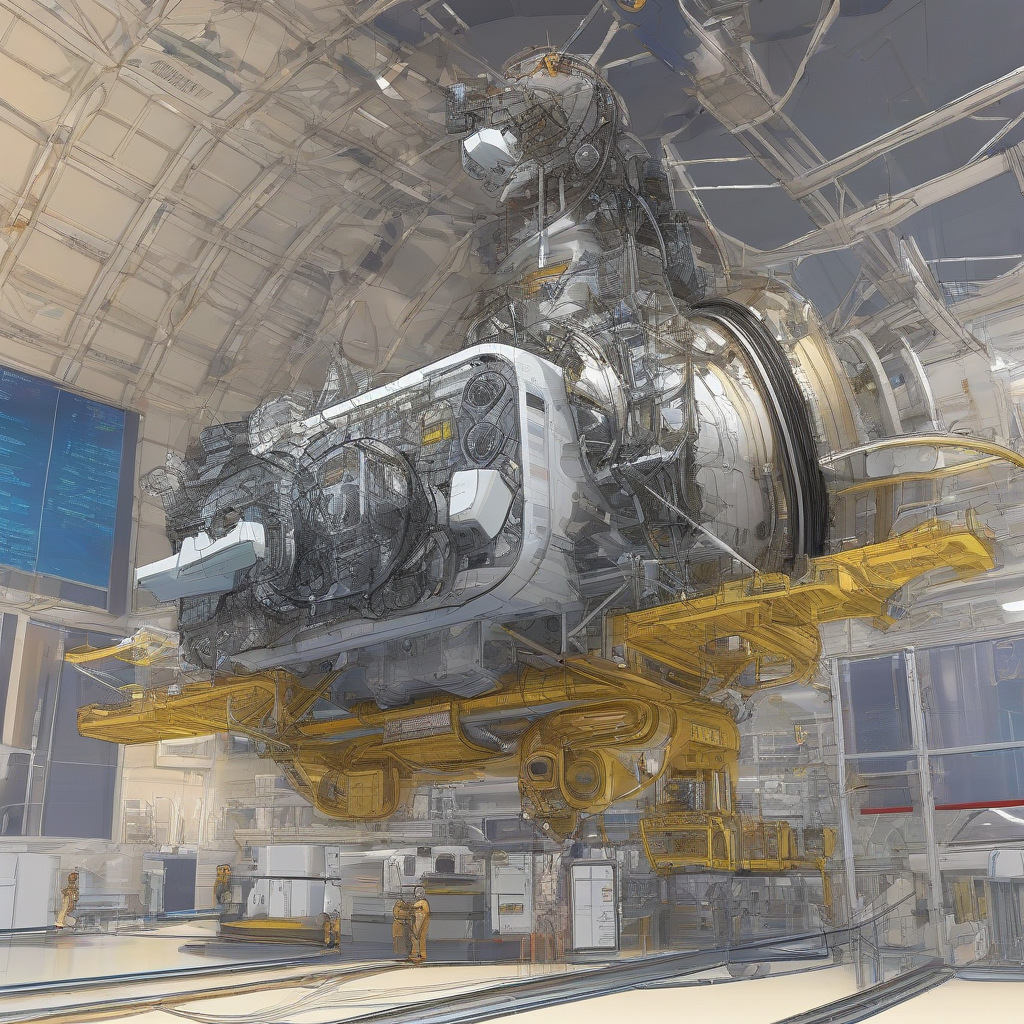
NASA’s Nancy Grace Roman Space Telescope Completed
Unlocking the Secrets of the Universe: NASA's Nancy Grace Roman Space Telescope Takes Shape
A New Era in Space Exploration
As the world waits with bated breath for the launch of NASA's Nancy Grace Roman Space Telescope, the agency's engineers and technicians have been working tirelessly to bring this ambitious project to life. The Roman Space Telescope, named after NASA's first chief astronomer, Dr. Nancy Grace Roman, is poised to revolutionize our understanding of the universe, and its completion marks a significant milestone in the history of space exploration.
The Roman Space Telescope: A Brief Overview
The Roman Space Telescope is a space-based observatory designed to study the universe in unprecedented detail. With a primary mirror spanning 2.4 meters in diameter, the telescope will be capable of capturing images and spectra of celestial objects with unparalleled resolution and sensitivity. The Roman Space Telescope will be equipped with a range of advanced instruments, including a camera, a spectrograph, and a coronagraph, which will enable scientists to study a wide range of phenomena, from the formation of the first stars and galaxies to the behavior of black holes and the properties of dark matter.
Construction and Testing: A Complex Process
The construction of the Roman Space Telescope involved a complex process of designing, building, and testing its various components. The telescope's primary mirror was manufactured using a advanced glass-ceramic material, which provides exceptional strength and stability. The mirror's surface was then polished to a precision of less than 10 nanometers, ensuring that it will produce high-quality images. The telescope's camera and spectrograph were designed and built by a team of engineers and scientists at NASA's Goddard Space Flight Center, who used advanced computer simulations and testing techniques to ensure that they will perform as expected.
Connecting the Inner and Outer Segments: A Critical Milestone
On November 25, 2025, technicians at NASA's Goddard Space Flight Center successfully connected the inner and outer segments of the Roman Space Telescope, marking a critical milestone in the project's construction. The inner segment, which houses the telescope's primary mirror and camera, was carefully aligned with the outer segment, which contains the spectrograph and coronagraph. The connection was made using a sophisticated system of mechanical and optical interfaces, which will enable the telescope to move smoothly and precisely.
Launch Preparations: The Next Step
After final testing and validation, the Roman Space Telescope will be transported to the launch site at NASA's Kennedy Space Center in Florida, where it will undergo a series of launch preparations. The telescope will be integrated with its launch vehicle, a SpaceX Falcon Heavy rocket, and will undergo a series of tests to ensure that it is ready for launch. The launch is currently scheduled for May 2027, but the team is working to bring it forward to as early as fall 2026.
Implications and Applications
The Roman Space Telescope will have a profound impact on our understanding of the universe, and its findings will have significant implications for a wide range of fields, from astrophysics and cosmology to planetary science and the search for life beyond Earth. The telescope will enable scientists to study the formation and evolution of galaxies, stars, and planets, and will provide insights into the properties of dark matter and dark energy. The Roman Space Telescope will also be used to search for exoplanets and study the atmospheres of distant worlds, which will help us better understand the conditions necessary for life to arise.
Conclusion
The completion of the Roman Space Telescope marks a significant milestone in the history of space exploration, and its launch will be a major step forward in our understanding of the universe. The telescope's advanced instruments and capabilities will enable scientists to study the universe in unprecedented detail, and its findings will have significant implications for a wide range of fields. As we look to the future, we can expect the Roman Space Telescope to continue to push the boundaries of our knowledge and understanding of the cosmos.
Source: https://www.nasa.gov/image-article/nasas-nancy-grace-roman-space-telescope-completed/