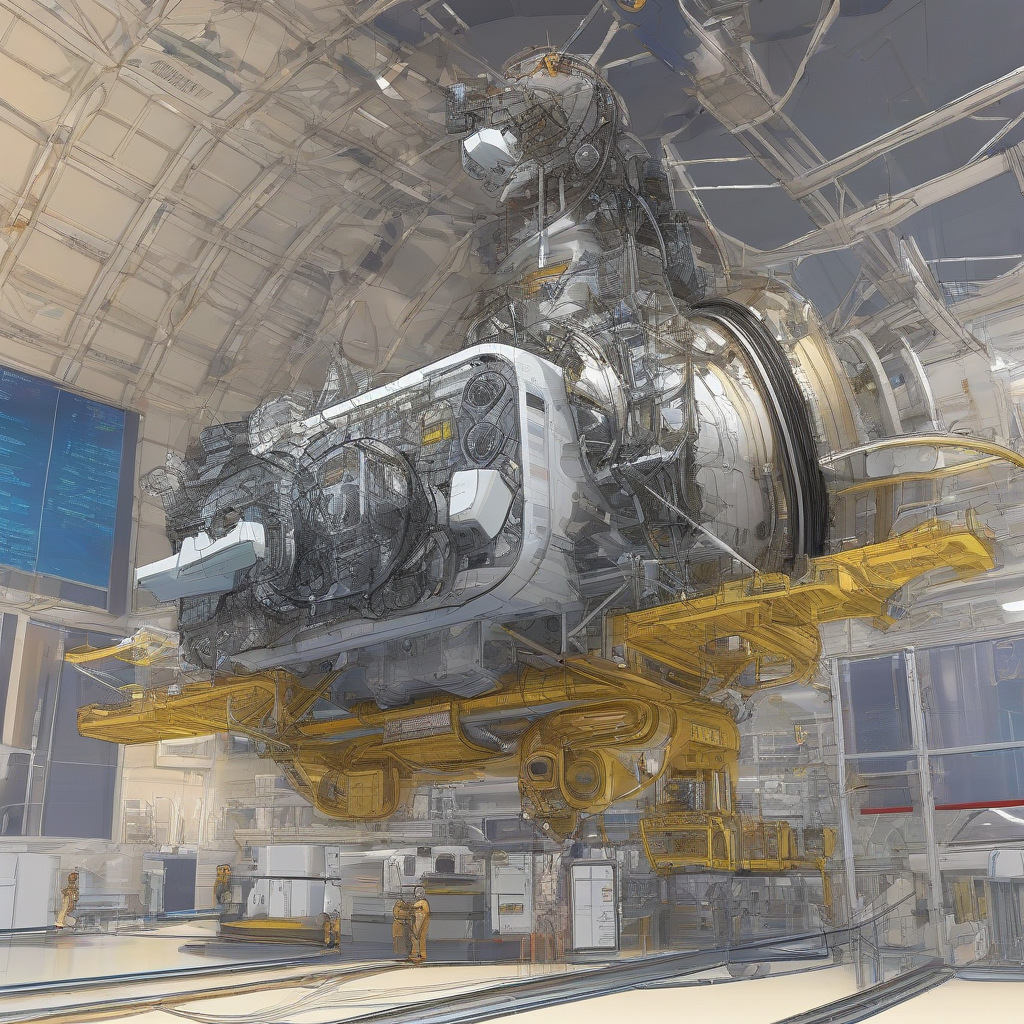
NASA’s Fly Foundational Robots Demo to Bolster In-Space Infrastructure
Revolutionizing In-Space Operations: NASA's Fly Foundational Robots Demo
As the world continues to push the boundaries of space exploration, NASA has announced an ambitious mission to revolutionize in-space operations with the Fly Foundational Robots (FFR) demo. Scheduled to launch in late 2027, this mission aims to demonstrate the capabilities of a commercial robotic arm in low Earth orbit, paving the way for a new era of sustainable space operations.
The Power of In-Space Robotics
In-space robotics has the potential to transform the way we conduct space missions, enabling a range of tasks that were previously impossible or impractical. From assembling solar arrays and refueling satellites to constructing lunar habitats and manufacturing products, the possibilities are endless. According to Bo Naasz, senior technical lead for In-space Servicing, Assembly, and Manufacturing (ISAM) at NASA Headquarters, "Today it's a robotic arm demonstration, but one day these same technologies could be assembling solar arrays, refueling satellites, constructing lunar habitats, or manufacturing products that benefit life on Earth."
The FFR Mission: A Testbed for In-Space Robotics
The FFR mission will leverage a robotic arm from small business Motiv Space Systems, capable of dexterous manipulation, autonomous tool use, and walking across spacecraft structures in zero or partial gravity. This mission will enable ways to repair and refuel spacecraft, construct habitats and infrastructure in space, maintain life support systems on lunar and Martian surfaces, and serve as robotic assistants to astronauts during extended missions.
A Commercial Robotic Arm in Space
To demonstrate FFR's commercial robotic arm in space, NASA's Space Technology Mission Directorate is contracting with Astro Digital to provide a hosted orbital test through the agency's Flight Opportunities program. The robotic arm will be launched on an Astro Digital spacecraft, where it will perform a series of robotic demonstrations in orbit.
Guest Roboticists Welcome
Guest roboticists will have the opportunity to contribute to the FFR mission, and participation will allow them to use Motiv's robotic platform as a testbed and perform unique tasks. NASA will serve as the inaugural guest operator and is currently seeking other interested U.S. partners to participate.
The Future of In-Space Robotics
The future of in-space robotics relies on testing robotic operations in space prior to launching more complex and extensive servicing and refueling missions. Through FFR, the demonstration of Motiv's robotic arm operations in space will begin to push open the door to endless possibilities.
Funding and Partnerships
NASA's Fly Foundational Robots demonstration is funded through the NASA Space Technology Mission Directorate's ISAM portfolio and managed by NASA's Goddard Space Flight Center in Greenbelt, Maryland. Motiv Space Systems of Pasadena, California, will supply the mission's robotic arm system through a NASA Small Business Innovation Research Phase III award. Astro Digital of Littleton, Colorado, will flight test Motiv's robotic payload through NASA's Flight Opportunities program managed by NASA's Armstrong Flight Research Center in Edwards, California.
Implications and Applications
The FFR mission has significant implications for a range of industries, including construction, medicine, and transportation. By advancing robotic systems in space, we can enhance our understanding of similar technologies on Earth, leading to breakthroughs in fields such as:
- Construction: Improved robotic construction techniques can lead to faster and more efficient building processes, reducing costs and increasing productivity.
- Medicine: Robotic systems can be used to develop new medical procedures and treatments, improving patient outcomes and quality of life.
- Transportation: Advanced robotic systems can be used to develop autonomous vehicles, improving safety and reducing the risk of accidents.
Conclusion
NASA's Fly Foundational Robots demo is a critical step towards revolutionizing in-space operations and paving the way for a new era of sustainable space exploration. By demonstrating the capabilities of a commercial robotic arm in space, this mission will enable a range of tasks that were previously impossible or impractical, transforming the way we conduct space missions and leading to breakthroughs in a range of industries. As we look to the future, it is clear that the possibilities are endless, and the potential for in-space robotics to transform our world is vast.