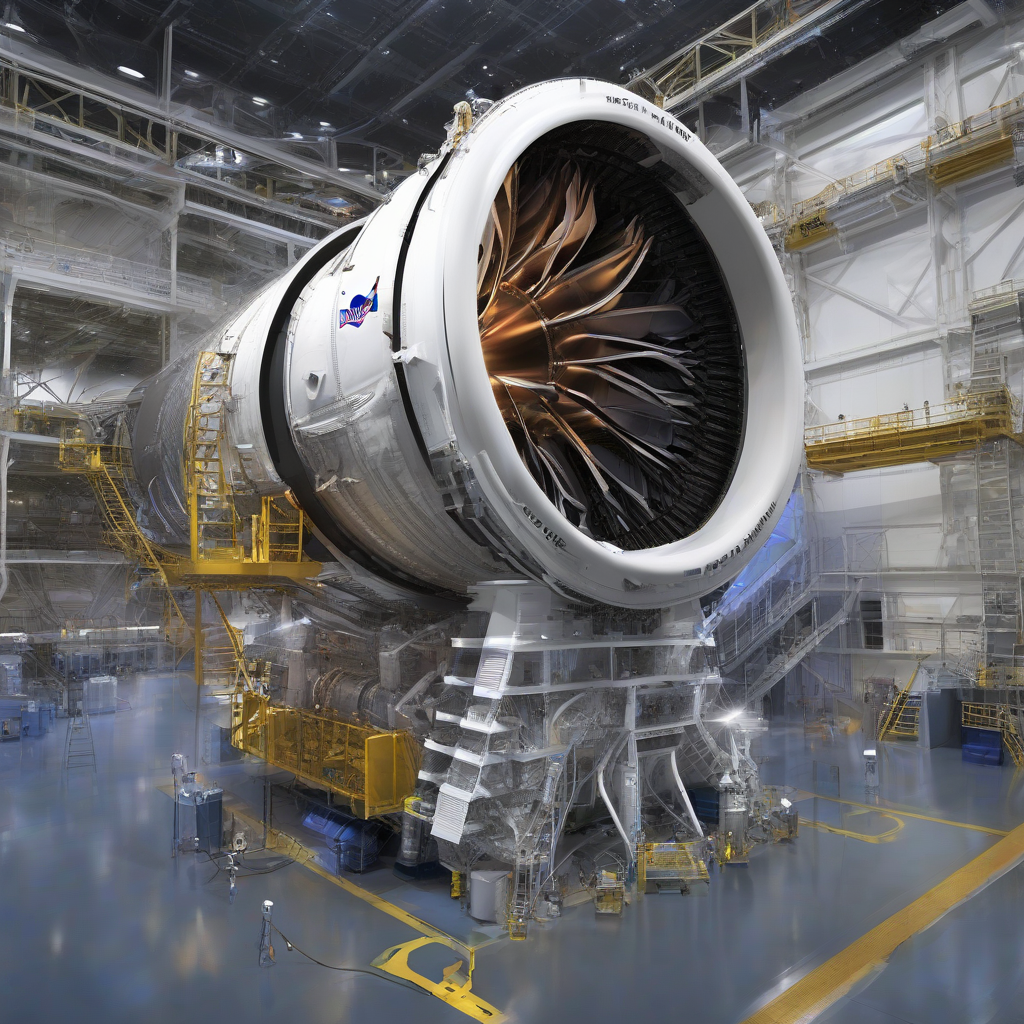
NASA, Partners Advance LISA Prototype Hardware
Unlocking the Secrets of the Universe: NASA's LISA Mission Advances with Prototype Hardware
As the universe continues to unfold its mysteries, scientists and engineers at NASA's Goddard Space Flight Center in Greenbelt, Maryland, have made significant progress on the Laser Interferometer Space Antenna (LISA) mission. This ambitious project, a collaboration between the European Space Agency (ESA) and NASA, aims to detect gravitational waves, or ripples in the fabric of space-time, using infrared lasers. The latest milestone achieved by the team involves the successful testing of a second early version of a key element of the LISA mission: the frequency reference system.
The Frequency Reference System: A Critical Component of LISA
The frequency reference system, delivered by BAE Systems, is a crucial component of the LISA mission. Its primary function is to control the lasers connecting the three LISA spacecraft, ensuring that they are finely tuned to make precise measurements. The lasers must be calibrated to within a trillionth of a meter, known as a picometer, to detect the minute changes in the lengths of the triangle's arms caused by gravitational waves.
A Prototype Laser Optical Module for LISA
A prototype laser optical module for LISA rests on a table after testing at NASA's Goddard Space Flight Center in Greenbelt, Maryland, in May 2025. The smaller box to the right is the laser electronics module. Each of the three LISA spacecraft will have a laser system with a frequency reference component and six laser heads.
The Extensive Round of Checkouts: A Success
The team tested the first version of the system in May 2025. "The extensive round of checkouts on the frequency reference system last year were very successful," said Ira Thorpe, the project scientist for LISA at NASA Goddard. "This second unit is identical, so our assessments this time around were less intense and preface a future cross-check of the two, which is the gold-standard for checking the stability of the system overall."
NASA's Contributions to the LISA Mission
In addition to the laser system, NASA is contributing the telescopes, devices to manage the buildup of onboard electrical charge, and the framework scientists will need to process the data the mission will generate. A prototype charge management device for LISA sits on a lab bench at NASA Goddard in May 2025. Each of the three LISA spacecraft will have a charge management device to reduce the buildup of electric charge on the gold-platinum proof masses that fly freely inside the spacecraft.
The LISA Spacecraft: A Vast Triangular Formation
The three LISA spacecraft will fly in a vast triangular formation that follows Earth as it orbits the Sun. Each arm of the triangle will stretch 1.6 million miles (2.5 million kilometers). Each spacecraft will contain two free-floating cubes inside called proof masses. Arriving gravitational waves from throughout the universe will minutely change the lengths of the triangle's arms. The lasers connecting the cubes will measure changes in their separation to within a distance smaller than a helium atom.
Implications of the LISA Mission
The LISA mission will offer a major advancement in multimessenger astronomy, which is how scientists explore cosmic signals other than light. The enormous scale of the triangle will enable LISA to detect gravitational waves that cannot be found with ground-based facilities, such as those generated when massive black holes in the centers of galaxies merge. Scientists can use the data to learn about a source's distance and physical properties.
Conclusion
The LISA mission is a groundbreaking project that will unlock the secrets of the universe. The successful testing of the frequency reference system is a significant milestone in the mission's progress. As the LISA spacecraft prepare to launch in the mid-2030s, scientists and engineers are eager to explore the mysteries of the universe and uncover new knowledge about the cosmos.
Forward-Looking Thoughts
The LISA mission is not just a scientific endeavor; it is also a technological innovation that will push the boundaries of what is possible. The development of the LISA spacecraft and the frequency reference system will have far-reaching implications for future space missions and the study of the universe. As we continue to explore the cosmos, we will uncover new mysteries and challenges that will require innovative solutions and cutting-edge technology. The LISA mission is a testament to human ingenuity and our desire to understand the universe and our place within it.
Source: https://science.nasa.gov/missions/lisa/nasa-partners-advance-lisa-prototype-hardware/