NASA Hubble’s New View of NGC 4394 Raises the Bar
Explore Hubble
3 min read
NASA Hubble’s New View of NGC 4394 Raises the Bar
NASA Hubble Mission Team
Goddard Space Flight Center
Nov 24, 2026
Article
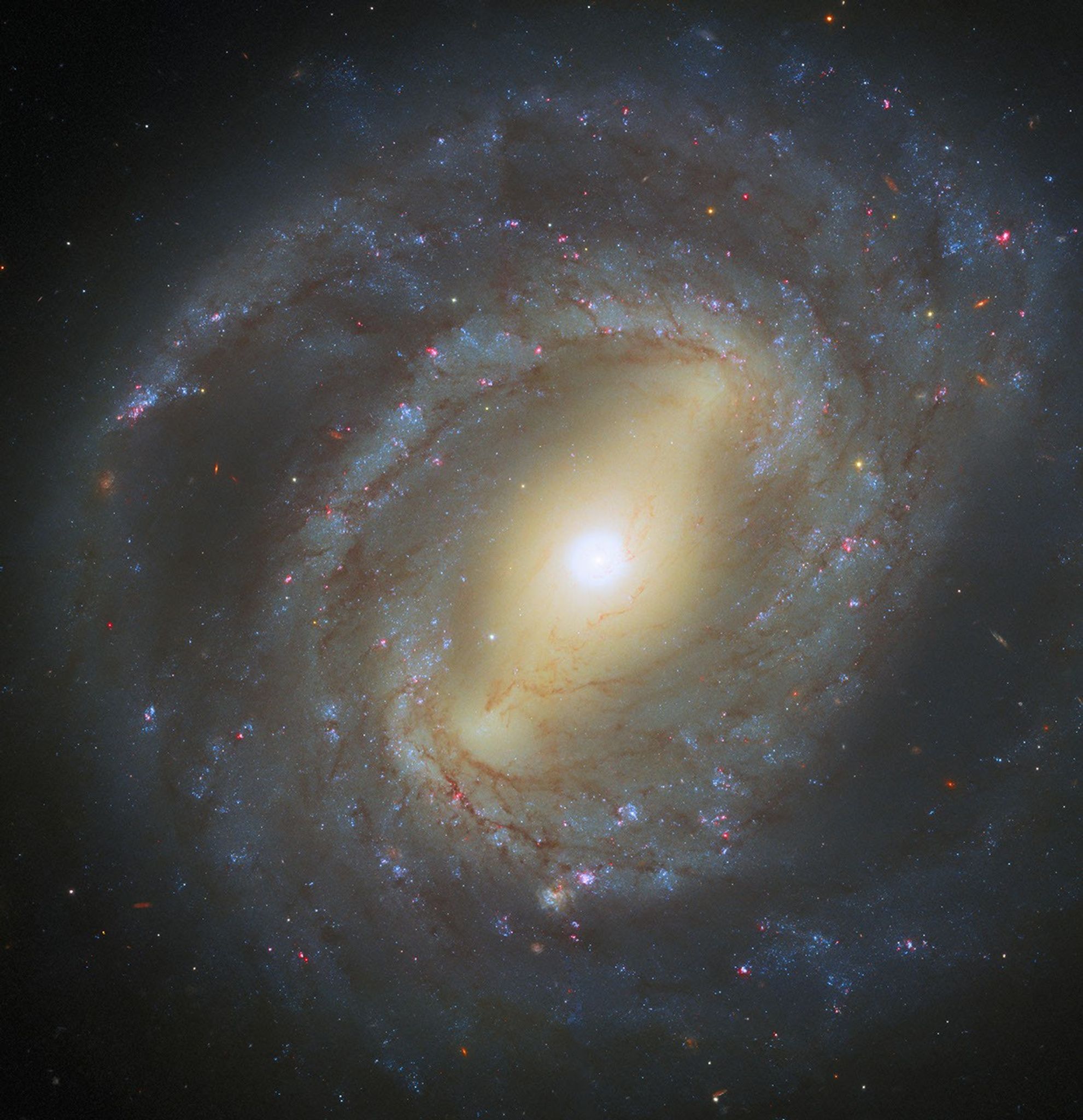
The brilliant galaxy NGC 4394 with its distinct galactic bar takes center stage in this NASA/ESA Hubble Space Telescope image.
ESA/Hubble & NASA, E. Peng, D. Thilker and the MAUVE-HST Team
A brilliant galaxy with a distinct galactic bar takes center stage in this NASA/ESA Hubble Space Telescope image. The galaxy, called NGC 4394, is in the constellation Coma Berenices (Berenice's Hair). At about 55 million light-years away, NGC 4394 is considered relatively nearby for a galaxy. It’s one of more than 1,000 galaxies that make up the Virgo Cluster, which is the galaxy cluster closest to us.
With its graceful spiral arms and central bar of stars, NGC 4394 closely resembles what astronomers think our home galaxy, the Milky Way, would look like if we were able to view it from a similar face-on vantage point. In a universe full of arcing spiral galaxies and nebulae organically shaped by the death and birth of stars, straight streaks of stars like NGC 4394’s galactic bar stand out. Galactic bars are extremely common; astronomers estimate 65 percent of nearby spiral galaxies have one. Hubble has imaged a wide variety of stunning barred spiral galaxies, including NGC 5728, NGC 685, and NGC 613, but how do these striking features form?
Explanations for how galactic bars might form tend to center on a galaxy’s disk of stars becoming unstable. This could happen because of gravitational nudges from passing galaxies, interactions between stars, or other forces. Once the disk becomes unstable, the circular orbits of stars become elongated, leading to the barred shape seen in galaxies like NGC 4394. Observations show that galactic bars are more common among galaxies in the universe today than they were several billion years ago. Though stellar bars are in fashion today, research suggests that this is only temporary; as bars become more massive, they can themselves become unstable.
In addition to their stellar bars and spiral arms, NGC 4394 and the Milky Way galaxy share another important similarity, in that they might both contain a LINER (low-ionization nuclear emission-line region). LINER refers to an area near the center of a galaxy where its spectra feature certain ionized or neutral elements. Researchers do not yet know exactly how LINERs form, though either hungry supermassive black holes or intense star formation likely play a role.
Hubble has paid a visit to NGC 4394’s patch of sky more than once, and a previous image of NGC 4394 was released a decade ago. That image was part of an observing program (#10515; PI: Peng) that focused on NGC 4394’s galactic neighbor, Messier 85. While one of Hubble’s instruments examined Messier 85 to study its unusual collection of star clusters, another (Hubble's Advanced Camera for Surveys) captured a parallel area of the sky that contained NGC 4394.
Today’s image also incorporates observations from a recent program (#18103; PI: Thilker) dedicated to understanding how star formation comes to an end in galaxies in dense cluster environments, and how this process differs from more isolated galaxies adrift in the field. For this observing program, researchers used Hubble’s Wide Field Camera 3 and its sensitivity to a broad wavelength range to determine the ages of individual star clusters. NGC 4394 is one of 40 galaxies they studied in this way.
Text credit: ESA/Hubble
			Facebook logo

			@NASAHubble

			@NASAHubble

			Instagram logo

			@NASAHubble
Media Contact:
Claire AndreoliNASA's Goddard Space Flight Center, Greenbelt, MDclaire.andreoli@nasa.gov
				Share

				Details

					Last Updated

				Nov 24, 2026

		Editor
Andrea Gianopoulos
Location
NASA Goddard Space Flight Center
Related Terms
Hubble Space Telescope
Astrophysics
Astrophysics Division
Galaxies
Goddard Space Flight Center
Spiral Galaxies
The Universe
				Keep Exploring

				Discover More Topics From Hubble

							Hubble Space Telescope

						Since its 1990 launch, the Hubble Space Telescope has changed our fundamental understanding of the universe.

							Hubble’s Galaxies

						Explore an assortment of galaxies with Hubble.

							Hubble Focus: Galaxies through Space and Time

						Hubble Focus: Galaxies through Space and Time

							Hubble Science Highlights

						Hubble's most notable scientific discoveries reflect the broad range of research and the breakthroughs it has achieved.
Source: https://science.nasa.gov/missions/hubble/nasa-hubbles-new-view-of-ngc-4394-raises-the-bar/