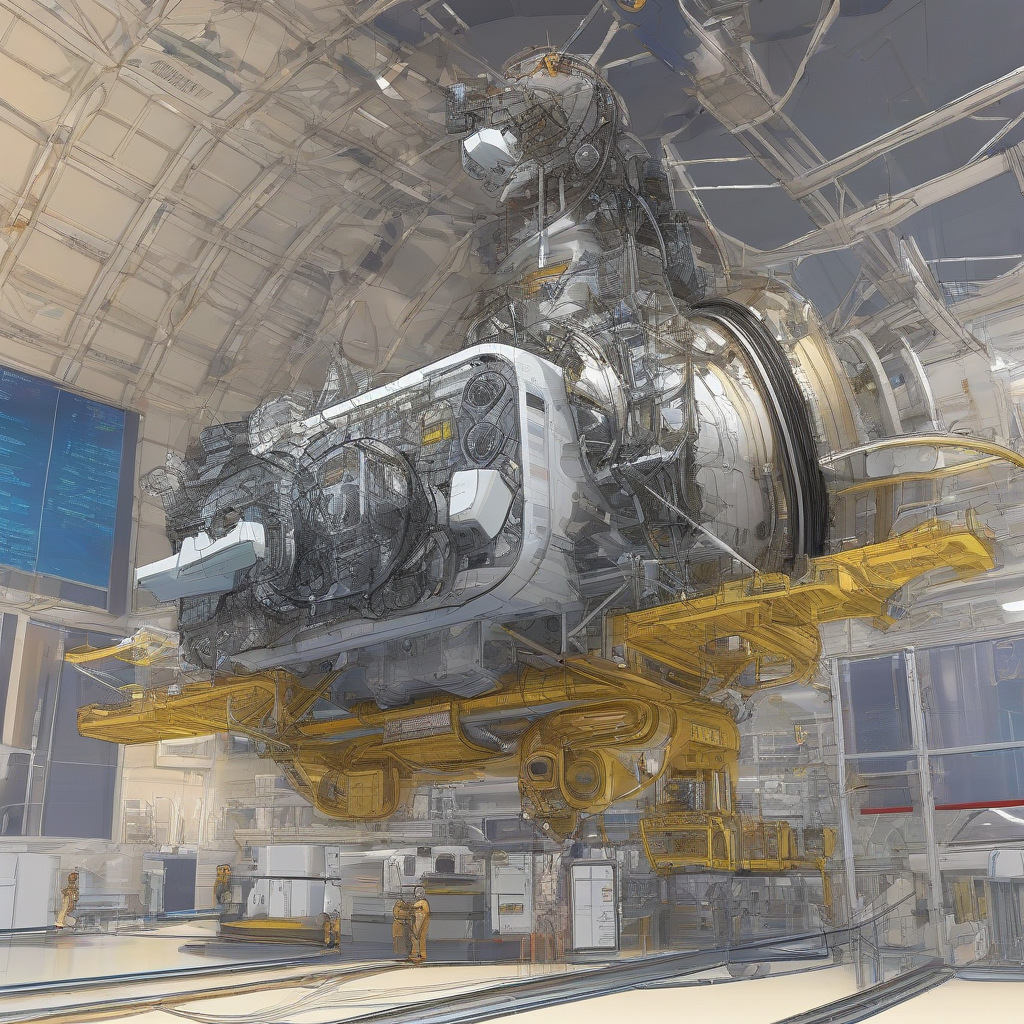
NASA Completes Nancy Grace Roman Space Telescope Construction
NASA's Nancy Grace Roman Space Telescope: A New Era in Cosmological Exploration
In a major milestone for space exploration, NASA's Nancy Grace Roman Space Telescope has completed its construction, marking a significant step towards unlocking the secrets of the universe. The telescope, named after NASA's first chief astronomer, is poised to revolutionize our understanding of the cosmos with its unprecedented capabilities.
A Cosmic Eye in Space
The Roman Space Telescope is designed to survey vast swaths of the sky, capturing images and spectra of galaxies, stars, and other celestial objects. Its primary instrument, the Wide Field Instrument, is a 288-megapixel camera that will unveil the cosmos all the way from our solar system to near the edge of the observable universe. With this instrument, each Roman image will capture a patch of the sky bigger than the apparent size of a full moon.
A Triple Threat of Surveys
Using the Wide Field Instrument, Roman will conduct three core surveys that will account for 75% of the primary mission. The High-Latitude Wide-Area Survey will combine the powers of imaging and spectroscopy to unveil more than a billion galaxies strewn across a wide swath of space and time. Astronomers will trace the evolution of the universe to probe dark matter – invisible matter detectable only by how its gravity affects things we can see – and trace the formation of galaxies and galaxy clusters over time.
Unveiling the Mysteries of Dark Energy
The High-Latitude Time-Domain Survey will probe our dynamic universe by observing the same region of the cosmos repeatedly. Stitching these observations together to create movies will allow scientists to study how celestial objects and phenomena change over time periods of days to years. This will help astronomers study dark energy – the mysterious cosmic pressure thought to accelerate the universe's expansion – and could even uncover entirely new phenomena that we don't yet know to look for.
A Galactic Bulge Time-Domain Survey
Roman's Galactic Bulge Time-Domain Survey will look inward to provide one of the deepest views ever of the heart of our Milky Way galaxy. Astronomers will watch hundreds of millions of stars in search of microlensing signals – gravitational boosts of a background star's light caused by the gravity of an intervening object. While astronomers have mainly discovered star-hugging worlds, Roman's microlensing observations can find planets in the habitable zone of their star and farther out, including worlds like every planet in our solar system except Mercury.
A Legacy of Discovery
The Nancy Grace Roman Space Telescope is a testament to the power of human curiosity and the importance of investing in space exploration. Its mission will acquire enormous quantities of astronomical imagery that will permit scientists to make groundbreaking discoveries for decades to come, honoring Dr. Roman's legacy in promoting scientific tools for the broader community.
A New Era in Cosmological Exploration
The Roman Space Telescope is a new era in cosmological exploration, one that will revolutionize our understanding of the universe and its many mysteries. With its unprecedented capabilities, it will unlock the secrets of dark energy, dark matter, and the formation of galaxies and galaxy clusters. The Roman Space Telescope is a shining example of what can be achieved when human ingenuity and curiosity come together to explore the vast expanse of space.
A Legacy for Future Generations
The Nancy Grace Roman Space Telescope will leave a lasting legacy for future generations of scientists and explorers. Its discoveries will inspire new generations to pursue careers in science, technology, engineering, and mathematics (STEM), and will continue to shape our understanding of the universe for centuries to come.
Conclusion
The completion of the Nancy Grace Roman Space Telescope marks a significant milestone in the history of space exploration. Its unprecedented capabilities will revolutionize our understanding of the universe and its many mysteries. As we look to the future, we can only imagine the incredible discoveries that will be made possible by this incredible instrument. The Roman Space Telescope is a testament to the power of human curiosity and the importance of investing in space exploration. Its legacy will be felt for generations to come.