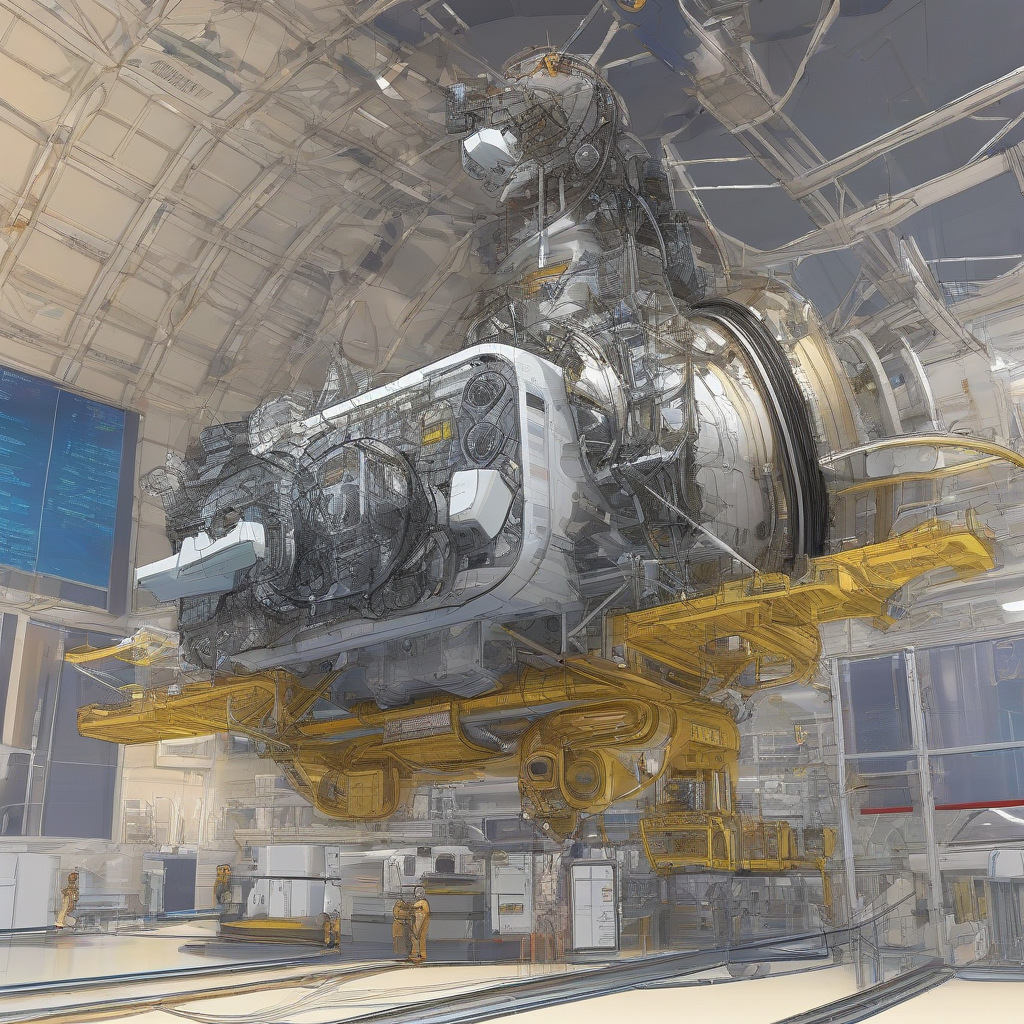
Meet Qingzhou, China's next-gen cargo craft for its Tiangong space station (video)
China's Next-Gen Cargo Craft: Meet Qingzhou, the Light Ship
China's space program is making significant strides with the development of a new, lighter, and potentially lower-cost cargo spacecraft option for its Tiangong space station. The Qingzhou spacecraft, meaning "Light Ship," is being developed by the Innovation Academy for Microsatellites of the Chinese Academy of Sciences (IAMCAS) as a smaller, more agile complement to China's existing Tianzhou cargo spacecraft.
A New Era for Tiangong
China completed its Tiangong space station in 2022, with plans to keep it permanently occupied with crew for at least a decade. As the country looks to expand the orbital outpost beyond its current three-module, T-shaped configuration, new solutions are needed to keep Tiangong supplied. The Qingzhou spacecraft is designed to meet this need, offering a more efficient and cost-effective way to transport cargo to the space station.
Design and Capabilities
The Qingzhou spacecraft measures roughly 10.8 feet (3.3 meters) in diameter, with a launch mass of about 11,000 pounds (5,000 kilograms). It is capable of carrying up to 4,000 pounds (1,800 kg) of cargo to orbit. The spacecraft's hybrid structure combines a pressurized module for crew supplies and sensitive instruments with an unpressurized aft section capable of carrying external payloads and space-exposure experiments.
Testing and Production
The Qingzhou spacecraft has passed a design review and entered the initial manufacturing phase. Full engineering model production is scheduled to begin in early 2026, with construction expected to be completed by the end of that year. The debut flight will follow based on the operational needs of the Tiangong station.
Implications and Applications
The development of the Qingzhou spacecraft marks a significant milestone in China's space program, offering a more efficient and cost-effective way to transport cargo to the Tiangong space station. This technology has practical implications for various industries, including:
- Space Exploration: The Qingzhou spacecraft can be used to transport supplies and equipment to future space stations, lunar bases, and Mars colonies.
- Commercial Spaceflight: The spacecraft's design and capabilities make it an attractive option for commercial spaceflight companies looking to transport cargo to low-Earth orbit.
- Scientific Research: The Qingzhou spacecraft can be used to transport scientific instruments and experiments to the Tiangong space station, enabling researchers to conduct experiments in microgravity.
Forward-Looking Thoughts
The development of the Qingzhou spacecraft is a significant step forward for China's space program, offering a more efficient and cost-effective way to transport cargo to the Tiangong space station. As the country continues to expand its space program, the Qingzhou spacecraft will play a critical role in enabling future missions and scientific research. With its capabilities and design, the Qingzhou spacecraft is poised to become a key player in the commercial spaceflight industry, offering a new era of space transportation and exploration.
Conclusion
The Qingzhou spacecraft is a significant development in China's space program, offering a more efficient and cost-effective way to transport cargo to the Tiangong space station. With its capabilities and design, the Qingzhou spacecraft is poised to become a key player in the commercial spaceflight industry, enabling future missions and scientific research. As the country continues to expand its space program, the Qingzhou spacecraft will play a critical role in shaping the future of space exploration and transportation.