Meet the Capability
Expectations around analytics have shifted, and the tools people rely on have to keep up. Most media & entertainment know the feeling: the answer is somewhere in the files, but reaching it means a queue, a query, or a rebuild. For media & entertainment, the difference between a fast decision and a stalled one often comes down to how quickly a simple question about the data gets a trustworthy answer.
What It Fixes
A recurring challenge for media & entertainment is answers that require sql nobody on the team can write. When answers that require sql nobody on the team can write sets in, decisions slow down and the data team drowns in ad-hoc requests. For a Senior Supply Chain, answers that require sql nobody on the team can write is more than an inconvenience — it is a daily drag on how fast the team can move. It rarely starts as a crisis; answers that require sql nobody on the team can write builds quietly until a board deadline makes it impossible to ignore. The issue shows up most clearly as Answers that require SQL nobody on the team can write across reporting and ad-hoc questions.
Inside the Capability
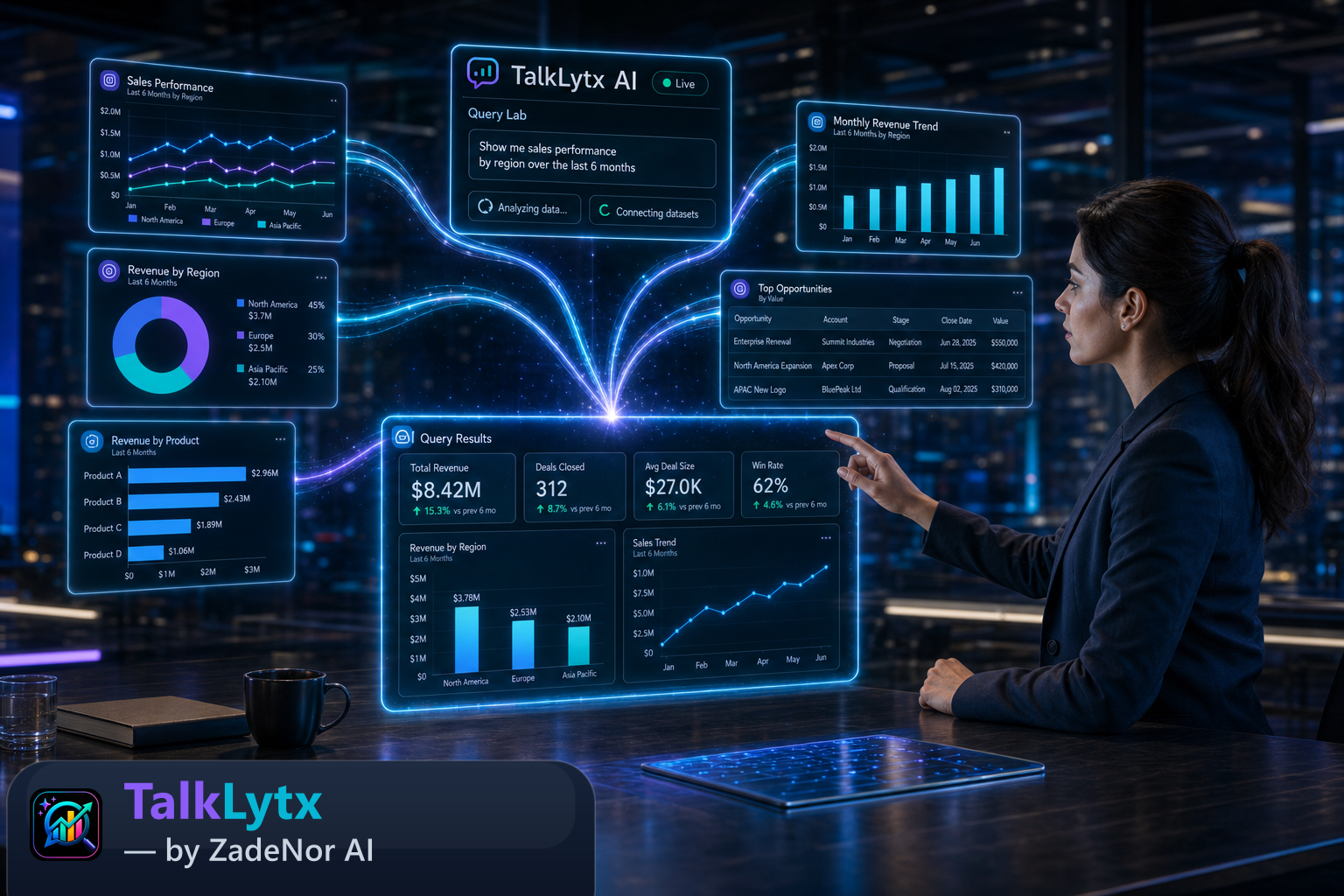
This is where TalkLytx comes in — the conversational data-analytics platform built by ZadeNor AI. TalkLytx connects natural-language questions, AI-generated SQL, and instant charts, so the whole analysis moves like a conversation. TalkLytx tackles this with Explained answers: Every response comes as a written answer alongside the SQL and a chart, so you understand not just the number but how it was reached. Because the answer, the SQL and the chart arrive together, you work from one transparent source of truth instead of a black box. Since explained answers sits within the Conversational Analytics capability set, it fits naturally into how media & entertainment already work.
How It Comes Together
Pin any chart or KPI to a dashboard your whole team can open and ask their own follow-ups on. The generated SQL is always visible and editable, so you can verify the logic behind any number instead of trusting a black box. Ask a question in plain English and TalkLytx writes the SQL, runs it, and answers with a written explanation and a chart. Queries can run in an in-browser DuckDB-Wasm engine, so URL-based analysis stays private and answers come back in sub-second time. Getting started is straightforward: drag in a CSV, JSON, Excel or PDF — or point TalkLytx at a URL — and start asking questions in seconds.
The Payoff
The result is ai-generated sql you can view and trust, without adding headcount or waiting on the queue. You get a calm, self-serve analytics workspace; decisions get faster and every team can answer its own questions. For media & entertainment, that means ai-generated sql you can view and trust you can actually rely on. People using this approach see AI-generated SQL you can view and trust.
Next Steps
Want ai-generated sql you can view and trust as a Media & Entertainment? Explore TalkLytx by ZadeNor AI and see how plain-English questions become answers, SQL and charts in seconds. No card required.
What looks like a tooling problem is often an access and trust problem in disguise. The cost of answers that require sql nobody on the team can write is rarely a single number — it is decisions made late, on stale data, or on gut feel. For leaders, the real risk is strategic: an analytics bottleneck becomes a ceiling on how fast the business can learn. The numbers follow the rigour: fewer ad-hoc requests, faster reporting cycles, and insight everyone can see. The result is ai-generated sql you can view and trust, without adding headcount or waiting on the queue.
Every hour lost to answers that require sql nobody on the team can write is an hour not spent on the decision the numbers were meant to inform. For leaders, the real risk is strategic: an analytics bottleneck becomes a ceiling on how fast the business can learn. Analytics stops being a bottleneck and starts being a shared, everyday capability. People using this approach see AI-generated SQL you can view and trust. The numbers follow the rigour: fewer ad-hoc requests, faster reporting cycles, and insight everyone can see.
For leaders, the real risk is strategic: an analytics bottleneck becomes a ceiling on how fast the business can learn. Every hour lost to answers that require sql nobody on the team can write is an hour not spent on the decision the numbers were meant to inform. What looks like a tooling problem is often an access and trust problem in disguise. The numbers follow the rigour: fewer ad-hoc requests, faster reporting cycles, and insight everyone can see. Analytics stops being a bottleneck and starts being a shared, everyday capability. For media & entertainment, that means ai-generated sql you can view and trust you can actually rely on.
Teams end up waiting on the BI queue instead of exploring the data themselves. What looks like a tooling problem is often an access and trust problem in disguise. The cost of answers that require sql nobody on the team can write is rarely a single number — it is decisions made late, on stale data, or on gut feel. The numbers follow the rigour: fewer ad-hoc requests, faster reporting cycles, and insight everyone can see. You get a calm, self-serve analytics workspace; decisions get faster and every team can answer its own questions. Analytics stops being a bottleneck and starts being a shared, everyday capability.