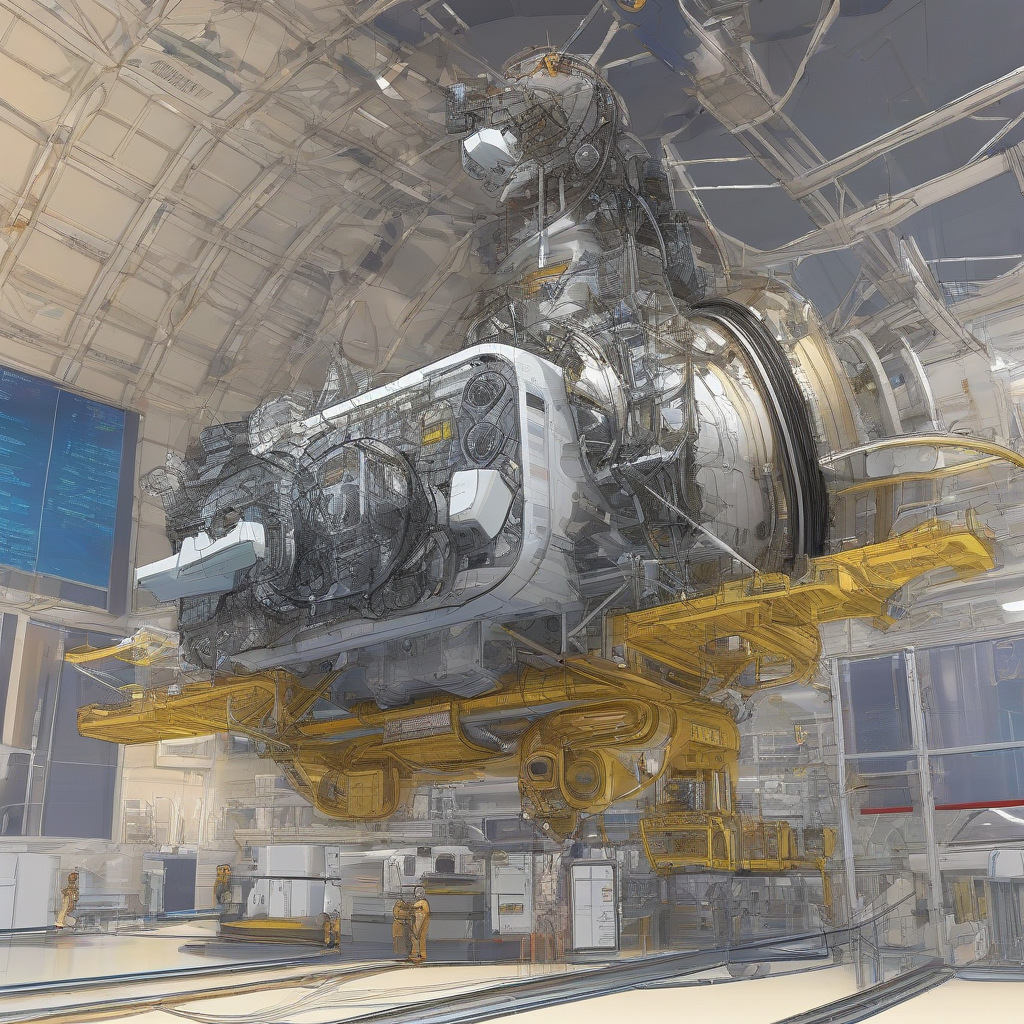
JPL 3D-Printed Part Springs Forward
Revolutionizing Space Technology: The JPL 3D-Printed Part Springs Forward
In a groundbreaking achievement, NASA's Jet Propulsion Laboratory (JPL) has successfully demonstrated the potential of additive manufacturing, also known as 3D printing, to cut costs and complexity for futuristic space antennas. The JPL Additive Compliant Canister (JACC), a 3D-printed spring designed to deploy on small commercial spacecraft, has shown that this technology can be used to build faster, cheaper, and less complex space hardware.
The JACC Success Story
The JACC spring was deployed on the small commercial spacecraft Proteus Space's Mercury One on February 3, 2026. An onboard camera captured a video of the spring popping out of its container as the spacecraft passed over the Pacific Ocean in low Earth orbit. The spring, which extends from a packed height of just over 1 inch to about 6 inches, is modeled after communication antennas commonly used on satellites.
The Benefits of 3D Printing in Space Technology
The success of JACC demonstrates the potential of 3D printing to revolutionize space technology. By combining multiple parts into a single 3D-printed component, JACC reduces the complexity and weight of traditional space hardware. This not only saves costs but also enables the use of more advanced materials and designs.
The JACC Design
JACC is a titanium 3D-printed spring that uses three times fewer parts than similar structures. The spring is designed to deploy and retract, and its compact size allows it to be stored in a small container. The JACC design is a significant improvement over traditional space hardware, which often requires multiple components and complex mechanisms.
The PANDORASBox Project
The JACC spring is part of the PANDORASBox project, a joint effort between JPL and Proteus Space to develop new technologies for space exploration. The project includes two demonstration payloads: JACC and the Solid Underconstrained Multi-Frequency (SUM) Deployable Antenna for Earth Science. Together, these payloads demonstrate the potential of 3D printing and advanced materials to improve space technology.
The Future of Space Technology
The success of JACC and the PANDORASBox project marks a significant milestone in the development of space technology. As the demand for space exploration and communication continues to grow, the need for innovative and cost-effective solutions becomes increasingly important. 3D printing and advanced materials are poised to play a major role in the future of space technology, enabling the development of more complex and sophisticated systems.
Practical Implications
The implications of JACC and the PANDORASBox project are far-reaching and have significant practical applications. The use of 3D printing and advanced materials can enable the development of more complex and sophisticated space systems, such as:
- Larger and more powerful communication antennas
- More advanced navigation systems
- Improved life support systems for long-duration space missions
- Enhanced robotics and artificial intelligence systems
Conclusion
The JPL 3D-printed part, JACC, has shown the potential of additive manufacturing to revolutionize space technology. The success of JACC and the PANDORASBox project marks a significant milestone in the development of space technology and has significant practical implications for the future of space exploration and communication. As the demand for space technology continues to grow, the use of 3D printing and advanced materials will become increasingly important, enabling the development of more complex and sophisticated systems.
Forward-Looking Thoughts
The future of space technology is bright, and the use of 3D printing and advanced materials will play a major role in its development. As we continue to push the boundaries of space exploration and communication, we can expect to see even more innovative and cost-effective solutions emerge. The JPL 3D-printed part, JACC, is just the beginning of a new era in space technology, and we can't wait to see what the future holds.
Source: https://science.nasa.gov/photojournal/jpl-3d-printed-part-springs-forward/