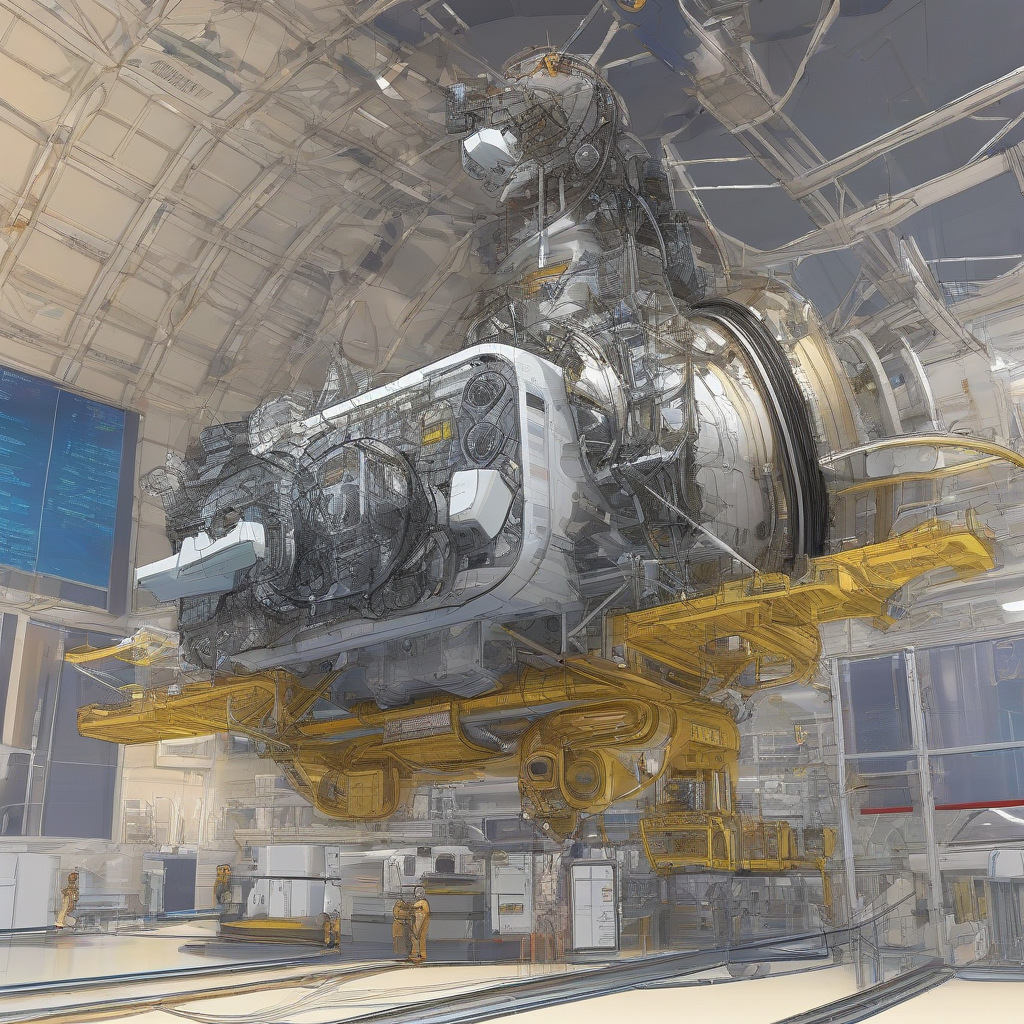
Journey to Center of Milky Way With Upcoming NASA Roman Core Survey
Journey to the Center of the Milky Way: Unveiling the Secrets of the Galactic Bulge
The Nancy Grace Roman Space Telescope, set to launch in 2027, will embark on a groundbreaking mission to explore the heart of our galaxy, the Milky Way. For five years, the telescope will conduct three revolutionary surveys, providing unprecedented insights into the dense thicket of stars at the galaxy's center. One of these surveys, the Galactic Bulge Time-Domain Survey, will focus on the exoplanets and stellar populations in the galactic bulge, a region of high star density.
The Galactic Bulge: A Region of High Star Density
The galactic bulge is a distinctive feature of the Milky Way, characterized by a high concentration of stars, gas, and dust. This region is thought to be the remnants of a massive merger between the Milky Way and a smaller galaxy, which occurred about 10 billion years ago. The galactic bulge is also home to a supermassive black hole, with a mass of approximately 4 million times that of our sun.
The Galactic Bulge Time-Domain Survey: A New Era in Exoplanet Detection
The Galactic Bulge Time-Domain Survey will be the highest precision, highest cadence, longest continuous observing baseline survey of the galactic bulge. The survey will observe six patches of the galactic bulge, one pinpointing the center and five nearby, every 12 minutes during 438 days of total observing time. This will provide an unprecedented volume of data for astronomers to parse through, allowing them to detect microlensing events, variable stars, and other celestial phenomena.
Microlensing: A Powerful Tool for Exoplanet Detection
Microlensing is a technique used to detect exoplanets by measuring the bending of light around a foreground object, such as a star. When a background star passes close to a foreground object, the light from the background star is bent, creating a magnified image. By monitoring the brightness of the background star, astronomers can detect the presence of an exoplanet. The Roman Space Telescope will use microlensing to detect exoplanets in the galactic bulge, providing a new window into the formation and evolution of planetary systems.
The Science Team: Bringing Together Experts from Around the World
The Galactic Bulge Time-Domain Survey is a collaborative effort between scientists from various research institutions, including the Space Telescope Science Institute, the University of Hawaii, and the California Institute of Technology. The team is led by Jessie Christiansen, a astrophysicist at the California Institute of Technology, who served as co-chair of the committee that defined the Galactic Bulge Time-Domain Survey.
The Roman Space Telescope: A Powerful Tool for Astronomical Research
The Nancy Grace Roman Space Telescope is a state-of-the-art space telescope designed to study the universe in unprecedented detail. The telescope will be equipped with a 2.4-meter primary mirror, which will allow it to collect light from distant objects with high precision. The Roman Space Telescope will be launched in 2027 and will spend five years conducting three revolutionary surveys, including the Galactic Bulge Time-Domain Survey.
Implications and Future Directions
The Galactic Bulge Time-Domain Survey will provide a wealth of new information about the formation and evolution of the Milky Way galaxy. The survey will also shed light on the properties of exoplanets and their host stars, providing insights into the conditions necessary for life to arise. The Roman Space Telescope will be a powerful tool for astronomers, allowing them to study the universe in unprecedented detail. As we continue to explore the universe, we may uncover new and exciting discoveries that will challenge our current understanding of the cosmos.
Conclusion
The Galactic Bulge Time-Domain Survey is a groundbreaking mission that will provide unprecedented insights into the formation and evolution of the Milky Way galaxy. The survey will use the Nancy Grace Roman Space Telescope to detect exoplanets and study the properties of stars in the galactic bulge. The Roman Space Telescope will be a powerful tool for astronomers, allowing them to study the universe in unprecedented detail. As we continue to explore the universe, we may uncover new and exciting discoveries that will challenge our current understanding of the cosmos.