
ZadeNor AI
ZadeNor AI
Back to Blog
Quantum Computing

IonQ Clears Final Regulatory Hurdle to Complete Acquisition of SkyWater Technology

July 31, 2026
5 min
1,328 views
By ZadeNor AI Team
IonQ Clears Final Regulatory Hurdle to Complete Acquisition of SkyWater Technology

IonQ Clears Final Regulatory Hurdle to Complete Acquisition of SkyWater Technology

IonQ Clears Final Regulatory Hurdle to Complete Acquisition of SkyWater Technology

Trapped-ion quantum hardware developer IonQ (NYSE: IONQ) has secured final regulatory approval to finalize its acquisition of SkyWater Technology (NASDAQ: SKYT), the largest exclusively U.S.-based semiconductor foundry. First announced as a definitive $1.8 billion cash-and-stock transaction in January 2026, the deal is set to close on July 31, 2026. Following transaction completion, SkyWater will operate as a wholly owned subsidiary under its existing brand, maintaining its commercial pure-play foundry model while providing IonQ with embedded, dedicated fabrication lines. The combined entity will hold its Q2 2026 financial earnings call on August 5, 2026, followed by an investor day scheduled for September 8, 2026.

Consolidating the Quantum Hardware Supply Chain

By acquiring a DMEA Category 1A Trusted Foundry, IonQ becomes the industry’s first vertically integrated, full-stack quantum platform company with direct control over design, wafer fabrication, advanced packaging, and system integration under a single domestic infrastructure.

Key operational benefits of the acquisition include:

Accelerated Technical Roadmap: Owning SkyWater’s Minnesota, Florida, and Texas facilities eliminates merchant foundry queue delays, reducing wafer iteration times. This capability pulls forward functional testing for IonQ’s 200,000 physical qubit QPUs (supporting 8,000+ logical qubits) to 2028 and accelerates development of its 2 million qubit chip architecture.

Co-Located Cryogenic Testing: SkyWater’s Minnesota facility integrates cryogenic wafer testing directly adjacent to manufacturing lines, ending the need to ship fragile wafers to third-party labs and closing the hardware iteration loop faster.

Defense & Sovereign Alignment: Embedded access to a U.S. trusted foundry secures an onshore supply chain, strengthening IonQ’s positioning across U.S. Department of Defense programs, including the Microelectronics Commons network and IonQ Federal initiatives.

Merchant Foundry Model and Broader Ecosystem Impact

SkyWater will continue serving its existing defense and commercial customer base across aerospace, industrial, and microelectronics sectors. While SkyWater has historically provided foundry services to other quantum ecosystem participants—such as D-Wave, EeroQ, Silicon Quantum Computing, and PsiQuantum—IonQ intends to leverage this merchant model to distribute its own proprietary quantum sensing and networking solutions through SkyWater’s established commercial channels.

Review the official transaction update on IonQ Investor here, and explore our previous coverage of the $1.8 Billion Acquisition Announcement here and the Economics of Quantum Fabrication here.

July 29, 2026

											Mohamed Abdel-Kareem2026-07-29T05:48:16-07:00																								

	Leave A Comment Cancel reply

Comment

		Type in the text displayed above			

Δ

This site uses Akismet to reduce spam. Learn how your comment data is processed.
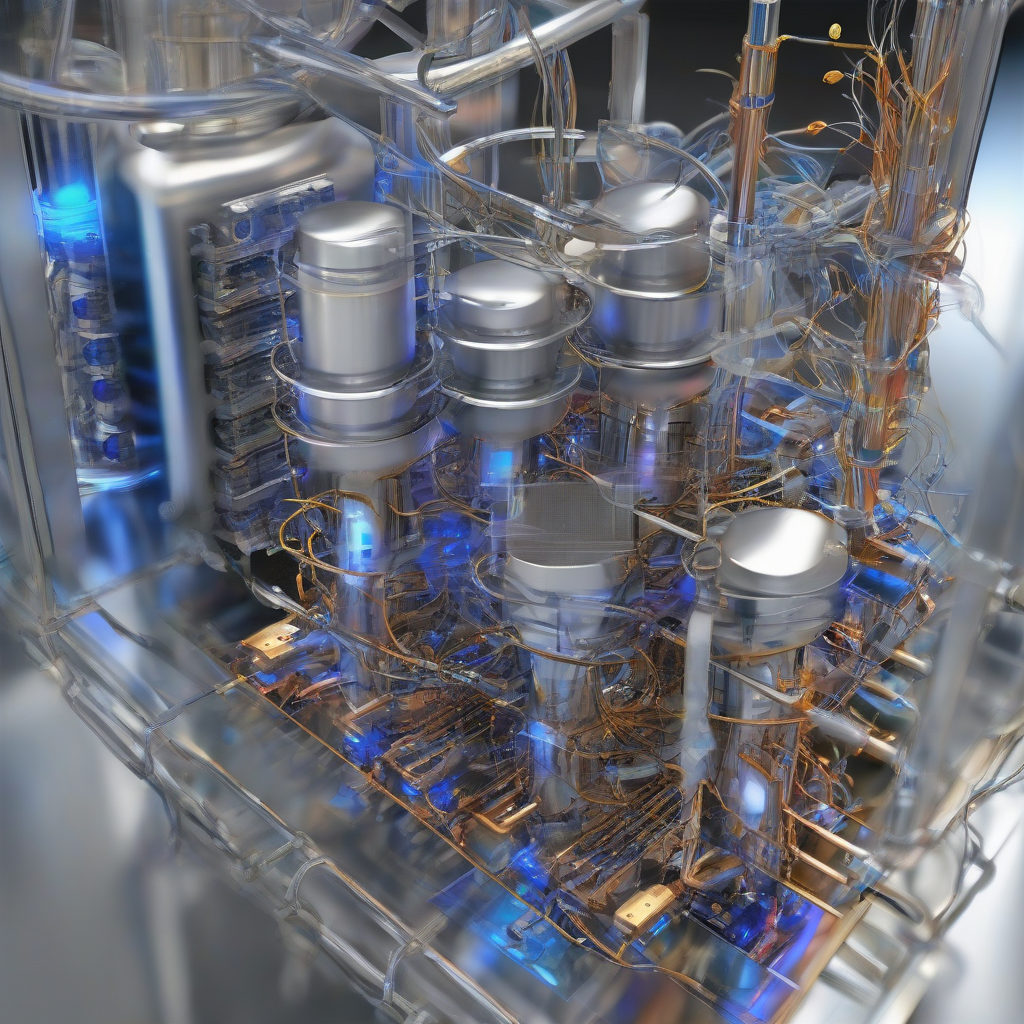
Source: https://quantumcomputingreport.com/ionq-clears-final-regulatory-hurdle-to-complete-acquisition-of-skywater-technology/

About the Author

ZadeNor AI Team is a leading expert in QUANTUM COMPUTING, contributing to cutting-edge research and development in the field.

Related Posts

Chalmers University Demonstrates TRIO Pulses for Control-Error-Robust Single-Qubit Gates in Superconducting Processors

Chalmers University Demonstrates TRIO Pulses for Control-Error-Robust Single-Qubit Gates in Superconducting Processors

Chalmers University of Technology has developed TRIO pulses, a new quantum control framework for superconducting processors. These pulses enable single-qubit gates to maintain high fidelity even with significant control-amplitude miscalibrations and frequency detuning errors. This breakthrough offers a way to reduce recalibration overheads in large-scale quantum processors and has been demonstrated with an X-gate achieving 99.90% fidelity. The post Chalmers University Demonstrates TRIO Pulses for Control-Error-Robust Single-Qubit Gates in Superconducting Processors appeared first on Quantum Computing Report. ]]>

337
5 min
Open Quantum Launches Native Qrisp Integration for High-Level QPU Execution Across IonQ, Rigetti, IQM, and AQT Hardware

Open Quantum Launches Native Qrisp Integration for High-Level QPU Execution Across IonQ, Rigetti, IQM, and AQT Hardware

Open Quantum has launched a native Qrisp integration, enabling high-level QPU execution across IonQ, Rigetti, IQM, and AQT hardware. This allows developers to compile and execute Qrisp programs directly on physical QPUs without writing vendor-specific gate-level code. The integration simplifies quantum programming by providing software-engineering abstractions, automated qubit allocation, and memory management. The post Open Quantum Launches Native Qrisp Integration for High-Level QPU Execution Across IonQ, Rigetti, IQM, and AQT Hardware appeared first on Quantum Computing Report. ]]>

416
5 min
RIKEN Demonstrates High-Fidelity Simultaneous Control of Silicon Spin Qubits Above 99.9% Threshold

RIKEN Demonstrates High-Fidelity Simultaneous Control of Silicon Spin Qubits Above 99.9% Threshold

Researchers at RIKEN and collaborators have achieved high-fidelity simultaneous control of five silicon spin qubits, maintaining over 99.9% accuracy. They overcame crosstalk caused by AC-Stark shifts through a new calibration protocol, enabling the use of a single microwave control line. This breakthrough meets the fault-tolerant threshold for quantum error correction and paves the way for more scalable quantum computers. The post RIKEN Demonstrates High-Fidelity Simultaneous Control of Silicon Spin Qubits Above 99.9% Threshold appeared first on Quantum Computing Report. ]]>

376
5 min