Picture This
The way a retail company handles questions says a lot about how it treats its customers. Most retail teams know the feeling: more questions than hours in the day. Support has quietly become one of the most important parts of the retail experience. For retail businesses, every customer conversation is a chance to build trust or lose it. In Retail, customers expect fast, accurate answers — and they notice when they do not get them.
The Friction
The issue shows up most clearly as Traffic spikes across the buyer journey. It rarely starts as a crisis; traffic spikes builds gradually until it is impossible to ignore. When traffic spikes sets in, customers wait longer and satisfaction slips. Left unaddressed, traffic spikes compounds: queues grow, answers get inconsistent, and good people burn out.
Enter TalkLinx
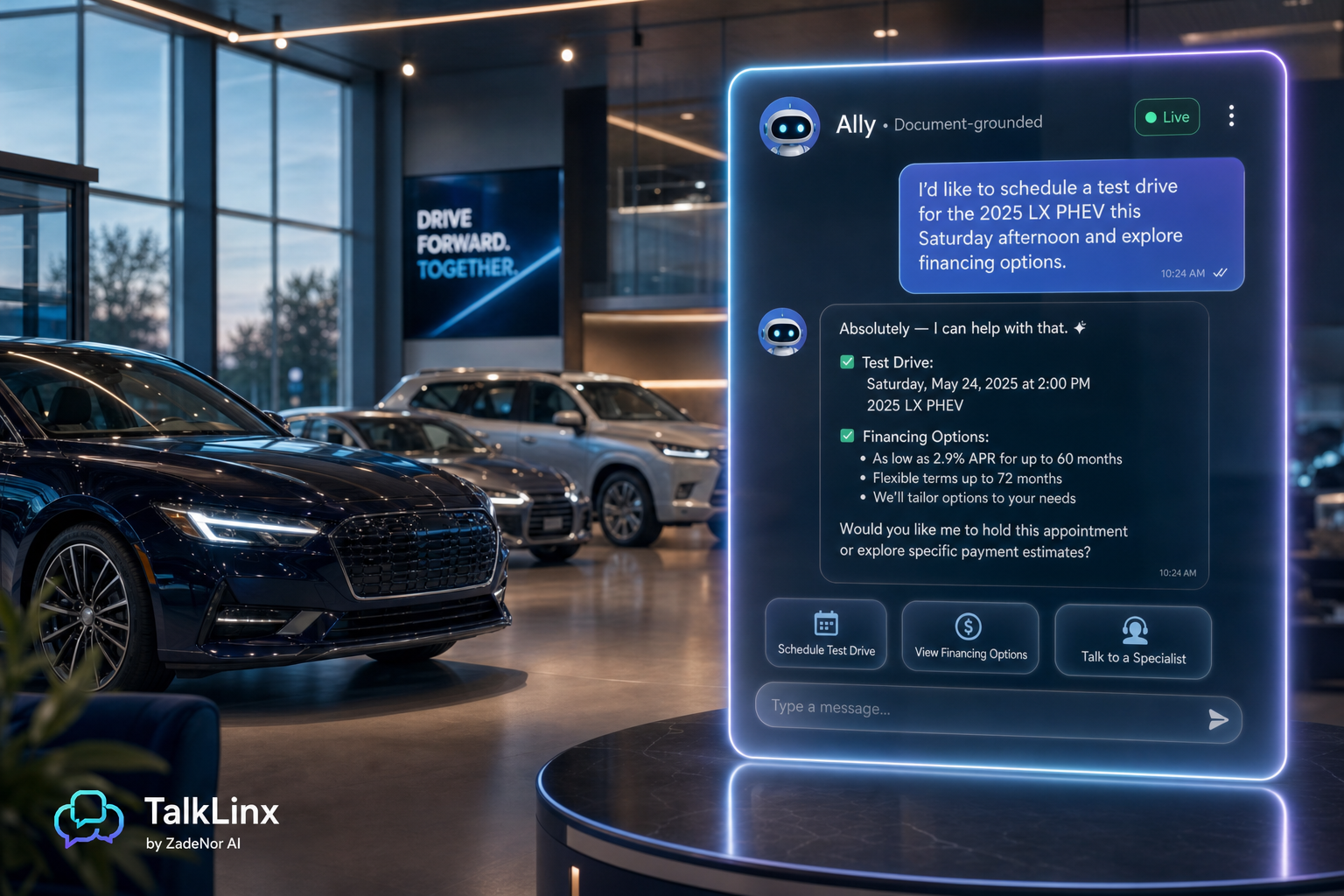
The assistant, named Ally, handles repetitive questions instantly and escalates the rest with full context. Rather than another generic chatbot, TalkLinx grounds every answer in your own knowledge base. TalkLinx learns from your documents and past conversations, so answers stay accurate and on-brand.
The Mechanics
You can embed the support widget on any page in minutes — no heavy integration project required. When a customer asks a question, the assistant retrieves the most relevant information and answers in plain language. Behind the scenes, every interaction is analyzed so trends surface without manual reporting. If a conversation needs a human, TalkLinx hands it off with the full thread and context attached. The assistant works across channels and languages, meeting customers wherever they are.
What Changes
Customers get instant, accurate answers; staff get time back for higher-value work. The numbers follow the experience: faster resolution, higher satisfaction, and lower cost to serve. The result is better operational efficiency in competitive markets, without adding headcount.
Explore TalkLinx
Want better operational efficiency in competitive markets without adding headcount? Explore TalkLinx by ZadeNor AI and give every customer an instant, accurate answer.
For leaders, the real risk is strategic: support quality becomes a ceiling on growth. Every delayed answer chips away at confidence in your retail brand. The cost of traffic spikes is rarely a single number — it is slower responses, frustrated customers, and lost opportunities. The result is better operational efficiency in competitive markets, without adding headcount. Teams using this approach see Better operational efficiency in competitive markets. The numbers follow the experience: faster resolution, higher satisfaction, and lower cost to serve.
Every delayed answer chips away at confidence in your retail brand. Over time, traffic spikes translates directly into churn, negative reviews, and rising cost to serve. Teams end up firefighting instead of focusing on the work that actually moves the business. Customers get instant, accurate answers; staff get time back for higher-value work. For retail businesses, that means better operational efficiency in competitive markets that customers can feel.
Teams end up firefighting instead of focusing on the work that actually moves the business. The cost of traffic spikes is rarely a single number — it is slower responses, frustrated customers, and lost opportunities. Every delayed answer chips away at confidence in your retail brand. For retail businesses, that means better operational efficiency in competitive markets that customers can feel. The result is better operational efficiency in competitive markets, without adding headcount.
Over time, traffic spikes translates directly into churn, negative reviews, and rising cost to serve. Every delayed answer chips away at confidence in your retail brand. For retail businesses, that means better operational efficiency in competitive markets that customers can feel. The result is better operational efficiency in competitive markets, without adding headcount. Teams using this approach see Better operational efficiency in competitive markets.
What looks like a support problem is often a revenue and retention problem in disguise. Teams end up firefighting instead of focusing on the work that actually moves the business. The result is better operational efficiency in competitive markets, without adding headcount. Support stops being a bottleneck and starts being a competitive advantage. The numbers follow the experience: faster resolution, higher satisfaction, and lower cost to serve.
Every delayed answer chips away at confidence in your retail brand. Teams end up firefighting instead of focusing on the work that actually moves the business. For retail businesses, that means better operational efficiency in competitive markets that customers can feel. Support stops being a bottleneck and starts being a competitive advantage. The numbers follow the experience: faster resolution, higher satisfaction, and lower cost to serve.
The cost of traffic spikes is rarely a single number — it is slower responses, frustrated customers, and lost opportunities. Over time, traffic spikes translates directly into churn, negative reviews, and rising cost to serve. Teams using this approach see Better operational efficiency in competitive markets. The numbers follow the experience: faster resolution, higher satisfaction, and lower cost to serve.
For leaders, the real risk is strategic: support quality becomes a ceiling on growth. What looks like a support problem is often a revenue and retention problem in disguise. Over time, traffic spikes translates directly into churn, negative reviews, and rising cost to serve. Teams using this approach see Better operational efficiency in competitive markets. Support stops being a bottleneck and starts being a competitive advantage.