Start Here
Dispatch and tracking have quietly become the place where chemical & hazmat transport fleets win or lose hours — and money. In Chemical & Hazmat Transport, the pressure is constant: move more freight, keep promises on time, and protect margin on every trip. The way a chemical & hazmat transport operation runs its day says a lot about how confidently it can grow.
The Challenge
Left unaddressed, lost or illegible paper proof of delivery compounds: trucks idle, paperwork piles up, and customers start calling. It rarely starts as a crisis; lost or illegible paper proof of delivery builds quietly until a peak day makes it impossible to ignore. A recurring challenge for chemical & hazmat transport fleets is lost or illegible paper proof of delivery. When lost or illegible paper proof of delivery sets in, the day tightens and the risk of a late delivery grows. The issue shows up most clearly as Lost or illegible paper proof of delivery across multiple branch operations.
The Approach
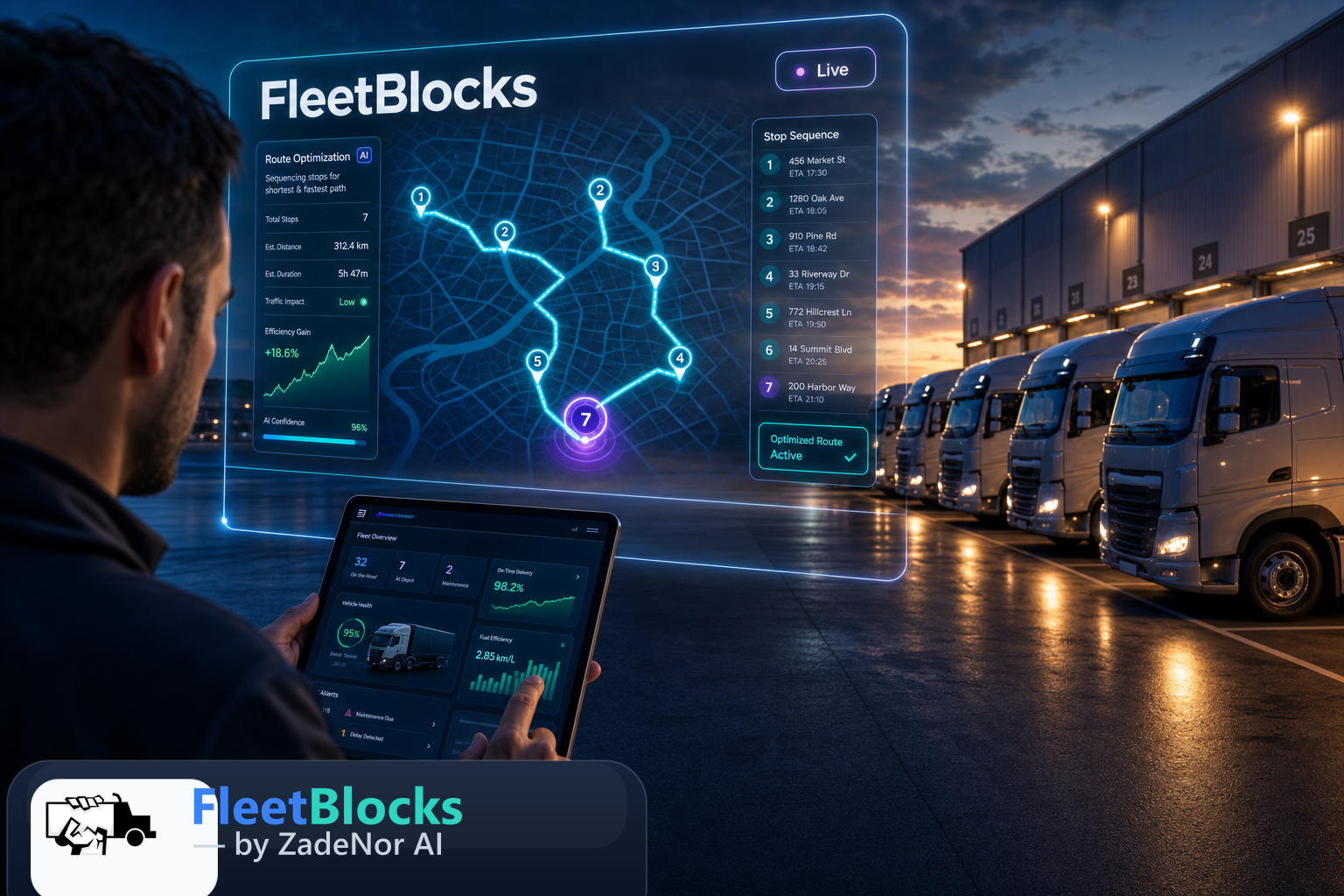
FleetBlocks tackles this with Document intelligence (OCR): A secure document library reads delivery orders, dates and amounts with AI OCR — no manual data entry, every scan searchable in seconds. Because everything lives together, the team works from a single source of truth instead of scattered files and phones. FleetBlocks connects dispatch, routing, tracking, proof of delivery and finance, so the whole operation moves as one. Rather than another spreadsheet, FleetBlocks puts every truck, every trip and every dollar on one calm screen.
The Payoff
Teams using this approach see Better fleet utilisation across the dispatch-to-cash cycle. Operations stop being a daily scramble and start being a competitive advantage. For chemical & hazmat transport fleets, that means better fleet utilisation the whole operation can rely on. Dispatchers get a calm, real-time command center; the business gets fuller trucks and faster cash. The result is better fleet utilisation, without trading away on-time performance or visibility.
Explore FleetBlocks
See how FleetBlocks — the AI-powered transport & logistics command center by ZadeNor AI — puts every truck, every trip and every dollar on one calm screen. Start free, no card required.
What looks like a dispatch problem is often a cash-flow and customer-trust problem in disguise. For owners, the real risk is strategic: operational drag becomes a ceiling on the freight the fleet can take on. Dispatchers get a calm, real-time command center; the business gets fuller trucks and faster cash. Operations stop being a daily scramble and start being a competitive advantage.
For owners, the real risk is strategic: operational drag becomes a ceiling on the freight the fleet can take on. The cost of lost or illegible paper proof of delivery is rarely a single number — it is empty miles, late drops, and avoidable disputes. Over time, lost or illegible paper proof of delivery translates into wasted fuel, missed windows, and margin no operator wants to give away. The numbers follow the rigour: fewer empty miles, more on-time drops, and a tidier back office. The result is better fleet utilisation, without trading away on-time performance or visibility. Operations stop being a daily scramble and start being a competitive advantage.
What looks like a dispatch problem is often a cash-flow and customer-trust problem in disguise. The cost of lost or illegible paper proof of delivery is rarely a single number — it is empty miles, late drops, and avoidable disputes. Every hour lost to lost or illegible paper proof of delivery is an hour not spent moving freight or serving the customer. The numbers follow the rigour: fewer empty miles, more on-time drops, and a tidier back office. Teams using this approach see Better fleet utilisation across the dispatch-to-cash cycle.
What looks like a dispatch problem is often a cash-flow and customer-trust problem in disguise. Teams end up firefighting instead of planning the most efficient, profitable runs. For chemical & hazmat transport fleets, that means better fleet utilisation the whole operation can rely on. Operations stop being a daily scramble and start being a competitive advantage. The result is better fleet utilisation, without trading away on-time performance or visibility.
Over time, lost or illegible paper proof of delivery translates into wasted fuel, missed windows, and margin no operator wants to give away. Every hour lost to lost or illegible paper proof of delivery is an hour not spent moving freight or serving the customer. The result is better fleet utilisation, without trading away on-time performance or visibility. Operations stop being a daily scramble and start being a competitive advantage.
For owners, the real risk is strategic: operational drag becomes a ceiling on the freight the fleet can take on. Every hour lost to lost or illegible paper proof of delivery is an hour not spent moving freight or serving the customer. The numbers follow the rigour: fewer empty miles, more on-time drops, and a tidier back office. Dispatchers get a calm, real-time command center; the business gets fuller trucks and faster cash.
Over time, lost or illegible paper proof of delivery translates into wasted fuel, missed windows, and margin no operator wants to give away. What looks like a dispatch problem is often a cash-flow and customer-trust problem in disguise. Teams using this approach see Better fleet utilisation across the dispatch-to-cash cycle. The numbers follow the rigour: fewer empty miles, more on-time drops, and a tidier back office. For chemical & hazmat transport fleets, that means better fleet utilisation the whole operation can rely on.