The Movement
Today, most teams react to questions instead of getting ahead of them. The status quo leans heavily on human availability, which simply cannot scale to demand. A clear signal is emerging: AI support assistants are moving from novelty to expectation.
The Background
Digital-first customers expect answers at any hour, on any channel. Regulatory pressure and rising expectations make consistent, accurate answers non-negotiable. The healthcare market rewards companies that make support effortless. Across Healthcare & Life Sciences, the bar for customer experience keeps rising.
The Hurdle
A recurring challenge for healthcare teams is traffic spikes. It rarely starts as a crisis; traffic spikes builds gradually until it is impossible to ignore. When traffic spikes sets in, customers wait longer and satisfaction slips.
What TalkLinx Enables
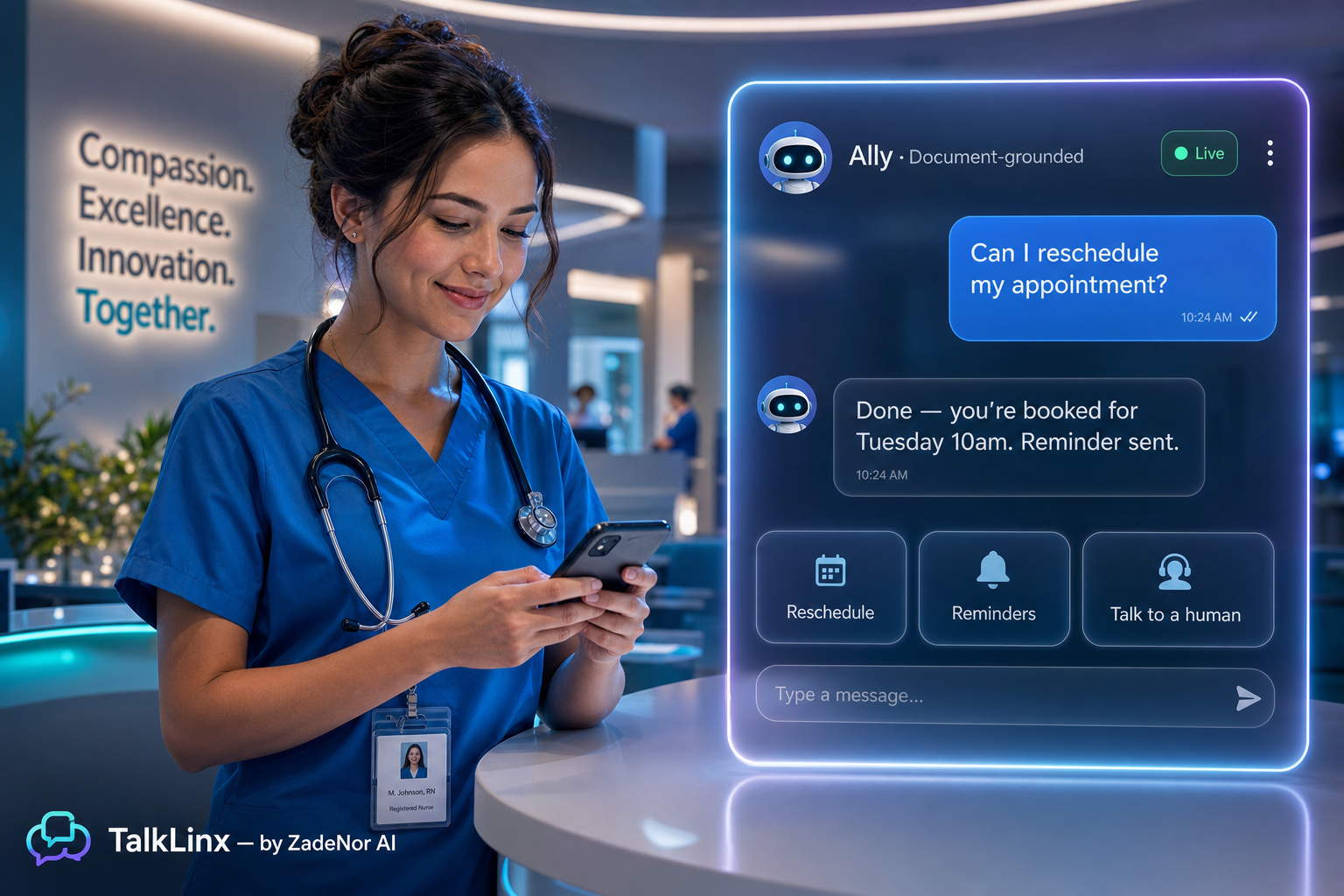
This is where TalkLinx comes in — the AI customer-support assistant built by ZadeNor AI. Because conversation tracking is part of the Business Intelligence capability set, it fits naturally into how healthcare teams already work. Rather than another generic chatbot, TalkLinx grounds every answer in your own knowledge base. The assistant, named Ally, handles repetitive questions instantly and escalates the rest with full context. TalkLinx learns from your documents and past conversations, so answers stay accurate and on-brand.
The Bottom Line
The numbers follow the experience: faster resolution, higher satisfaction, and lower cost to serve. The result is reduced churn, without adding headcount. Support stops being a bottleneck and starts being a competitive advantage. For healthcare businesses, that means reduced churn that customers can feel. Teams using this approach see Reduced churn for mobile-first customers.
Take the Next Step
Give your Healthcare customers the support experience they expect. Try TalkLinx — built by ZadeNor AI — and see the difference an always-on assistant makes.
For leaders, the real risk is strategic: support quality becomes a ceiling on growth. What looks like a support problem is often a revenue and retention problem in disguise. The cost of traffic spikes is rarely a single number — it is slower responses, frustrated customers, and lost opportunities. For healthcare businesses, that means reduced churn that customers can feel. The numbers follow the experience: faster resolution, higher satisfaction, and lower cost to serve. Customers get instant, accurate answers; staff get time back for higher-value work.
Every delayed answer chips away at confidence in your healthcare brand. For leaders, the real risk is strategic: support quality becomes a ceiling on growth. The cost of traffic spikes is rarely a single number — it is slower responses, frustrated customers, and lost opportunities. Customers get instant, accurate answers; staff get time back for higher-value work. The numbers follow the experience: faster resolution, higher satisfaction, and lower cost to serve. For healthcare businesses, that means reduced churn that customers can feel.
Every delayed answer chips away at confidence in your healthcare brand. For leaders, the real risk is strategic: support quality becomes a ceiling on growth. Support stops being a bottleneck and starts being a competitive advantage. The result is reduced churn, without adding headcount. The numbers follow the experience: faster resolution, higher satisfaction, and lower cost to serve.
Teams end up firefighting instead of focusing on the work that actually moves the business. The cost of traffic spikes is rarely a single number — it is slower responses, frustrated customers, and lost opportunities. Over time, traffic spikes translates directly into churn, negative reviews, and rising cost to serve. The result is reduced churn, without adding headcount. Teams using this approach see Reduced churn for mobile-first customers.
Over time, traffic spikes translates directly into churn, negative reviews, and rising cost to serve. What looks like a support problem is often a revenue and retention problem in disguise. Teams end up firefighting instead of focusing on the work that actually moves the business. Teams using this approach see Reduced churn for mobile-first customers. For healthcare businesses, that means reduced churn that customers can feel. The result is reduced churn, without adding headcount.
For leaders, the real risk is strategic: support quality becomes a ceiling on growth. Every delayed answer chips away at confidence in your healthcare brand. Teams end up firefighting instead of focusing on the work that actually moves the business. Support stops being a bottleneck and starts being a competitive advantage. Teams using this approach see Reduced churn for mobile-first customers.
Over time, traffic spikes translates directly into churn, negative reviews, and rising cost to serve. Teams end up firefighting instead of focusing on the work that actually moves the business. Teams using this approach see Reduced churn for mobile-first customers. The result is reduced churn, without adding headcount.
The cost of traffic spikes is rarely a single number — it is slower responses, frustrated customers, and lost opportunities. Every delayed answer chips away at confidence in your healthcare brand. Over time, traffic spikes translates directly into churn, negative reviews, and rising cost to serve. The result is reduced churn, without adding headcount. For healthcare businesses, that means reduced churn that customers can feel. The numbers follow the experience: faster resolution, higher satisfaction, and lower cost to serve.