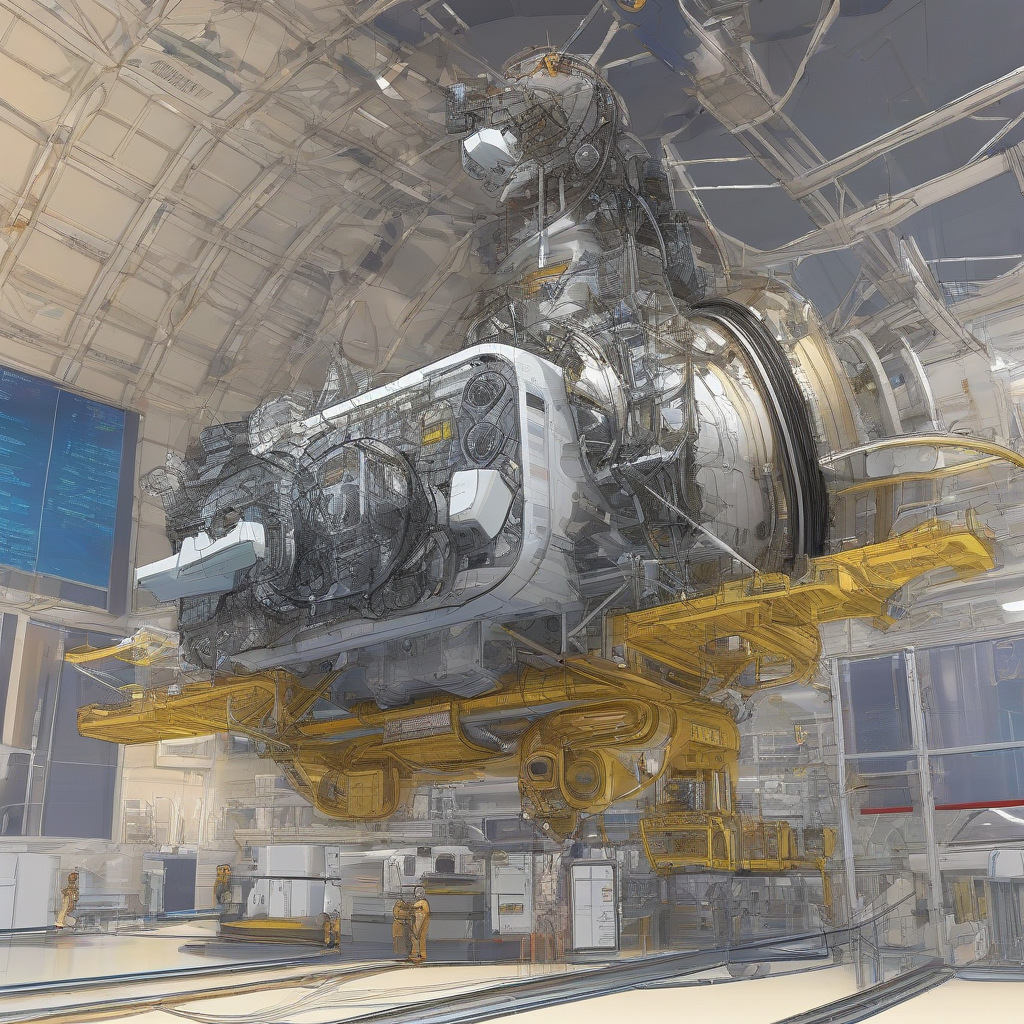
Flight Engineers Give NASA’s Dragonfly Lift
Flight Engineers Give NASA's Dragonfly Lift
In a groundbreaking effort to explore Saturn's moon Titan, NASA's Dragonfly mission is on the cusp of a monumental journey. The mission, set to launch in 2028, will send a car-sized rotorcraft to the distant moon, where it will exploit the dense atmosphere and low gravity to fly to dozens of locations, exploring varied environments from organic equatorial dunes to an impact crater where liquid water and complex organic materials essential to life may have existed together.
The Team Behind the Mission
The Dragonfly mission has been a collaborative effort from the start, with contributions from organizations around the world. The Johns Hopkins Applied Physics Laboratory (APL) in Laurel, Maryland, leads the mission for NASA in collaboration with several NASA centers, industry partners, academic institutions, and international space agencies. Elizabeth "Zibi" Turtle of APL is the principal investigator, and the mission is part of NASA's New Frontiers Program, managed by the Planetary Missions Program Office at NASA Marshall Space Flight Center in Huntsville, Alabama, for the agency's Science Mission Directorate in Washington.
Critical Technical Trials
When full rotorcraft integration and testing begins in early 2026, the mission team will tap into a trove of data gathered through critical technical trials conducted over the past three years, including, most recently, a testing campaign in the Transonic Dynamics Tunnel (TDT) Facility at NASA's Langley Research Center in Hampton, Virginia. The TDT is a versatile 16-foot-high, 16-foot-wide, 20-foot-long testing hub that has hosted studies for NASA, the Department of War, the aircraft industry, and an array of universities.
Evaluating the Performance of Dragonfly's Rotor System
Over five weeks, from August into September, the team evaluated the performance of Dragonfly's rotor system – which provides the lift for the lander to fly and enables it to maneuver – in Titan-like conditions, looking at aeromechanical performance factors such as stress on the rotor arms, and effects of vibration on the rotor blades and lander body. In late December, the team also wrapped up a set of aerodynamics tests on smaller-scale Dragonfly rotor models in the TDT.
Fabricating the Rotors
Experimental machinist Cory Pennington has crafted parts for projects dispatched around the globe, but fashioning rotors for a drone to explore another world in our solar system? That was new – and a little daunting. "The rotors are some of the most important parts on Dragonfly," Pennington said. "Without the rotors, it doesn't fly – and it doesn't meet its mission objectives at Titan."
Collaboration and Innovation
Elizabeth "Zibi" Turtle, Dragonfly principal investigator at APL, says the latest work in the TDT demonstrates the mission's innovation, ingenuity, and collaboration across government and industry. "The team worked well together, under time pressure, to develop solutions, assess design decisions, and execute fabrication and testing," she said. "There's still much to do between now and our launch in 2028, but everyone who worked on this should take tremendous pride in these accomplishments that make it possible for Dragonfly to fly on Titan."
Next Steps
The rotors will undergo fatigue and cryogenic trials under simulated Titan conditions, where the temperature is minus 290 degrees Fahrenheit (minus 178 degrees Celsius), before building the actual flight rotors. "We're not just cutting metal — we're fabricating something that's going to another world," Pennington said. "It's incredible to know that what we build will fly on Titan."
Implications and Future Directions
The Dragonfly mission has the potential to revolutionize our understanding of the Saturnian system and the search for life beyond Earth. The mission's innovative approach to exploring a distant moon and its atmosphere will provide valuable insights into the origins of life and the potential for life to exist elsewhere in the universe. As the mission team continues to work towards the launch in 2028, the possibilities for discovery and exploration are endless.
Conclusion
The Dragonfly mission is a testament to the power of collaboration and innovation in space exploration. The team's dedication to pushing the boundaries of what is possible has brought us closer to understanding the mysteries of the Saturnian system and the search for life beyond Earth. As we look to the future, the possibilities for discovery and exploration are endless, and the Dragonfly mission is just the beginning.
Source: https://www.nasa.gov/missions/dragonfly/flight-engineers-give-nasas-dragonfly-lift/