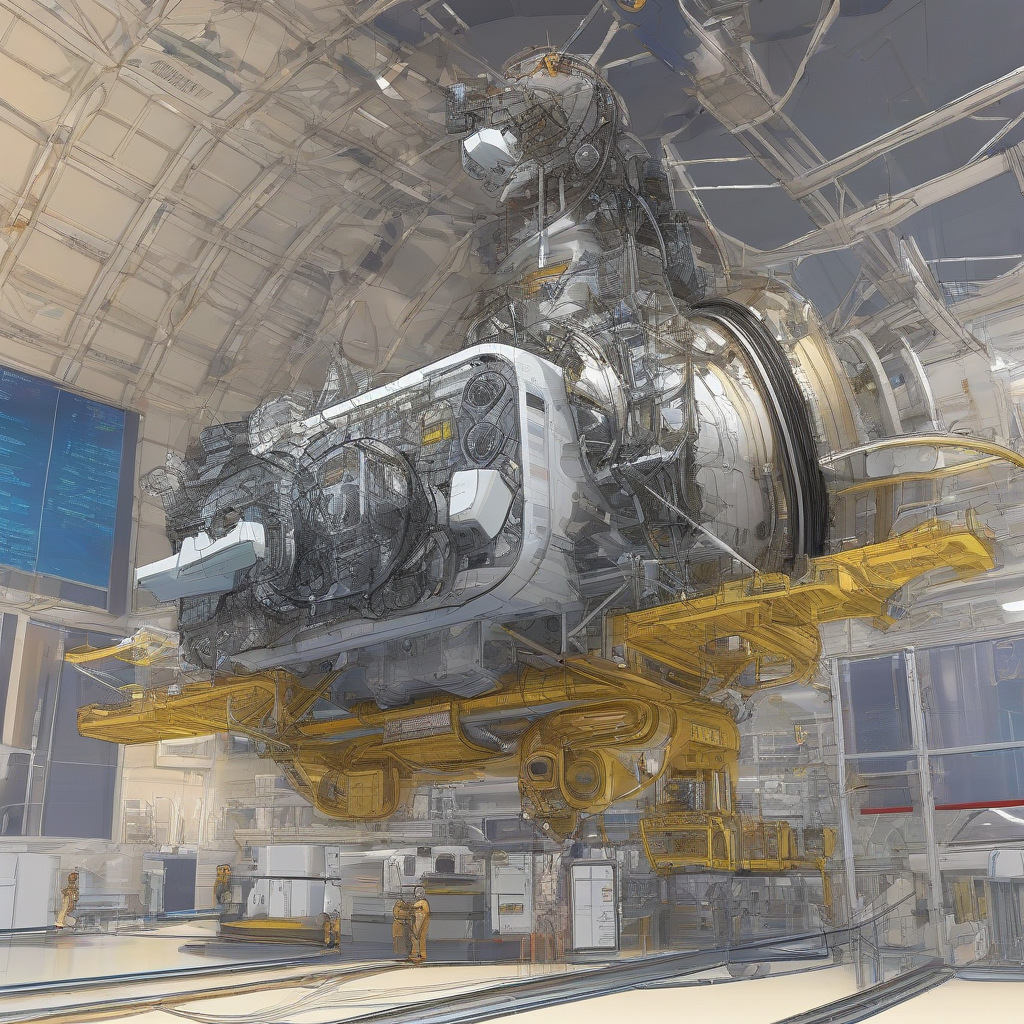
Building Roman
The Nancy Grace Roman Space Telescope: A New Era in Space Exploration
The Nancy Grace Roman Space Telescope, named after the first woman to lead NASA's astronomy program, is a groundbreaking mission that promises to revolutionize our understanding of the universe. With its advanced technology and cutting-edge design, Roman is poised to make unprecedented discoveries and shed new light on the mysteries of the cosmos.
The Telescope's Heart: The Optical Telescope Assembly
At the heart of the Roman observatory lies the Optical Telescope Assembly (OTA), a marvel of engineering that consists of a primary mirror, nine additional mirrors, and supporting structures and electronics. The OTA was designed and built at L3Harris Technologies in Rochester, New York, and was delivered to NASA's Goddard Space Flight Center in November 2024.
The primary mirror, which is 7.9 feet (2.4 meters) across, is the largest component of the OTA. It was designed to collect and focus light from cosmic objects near and far, and its surface is so finely polished that the average bump on its surface is only 1.2 nanometers tall. The mirror's silver coating, which is less than 400 nanometers thick, was specifically chosen for Roman because of its ability to reflect near-infrared light.
Detectors: The Key to Unlocking the Universe's Secrets
The detector array, developed by technicians at Goddard and Teledyne Scientific & Imaging, is a critical component of the Roman observatory. This device converts starlight into electrical signals, which are then decoded into 288-megapixel images of large patches of the sky. The combination of Roman's fine resolution and enormous images has never been possible on a space-based telescope before.
The Wide Field Instrument: A Sweeping Cosmic Survey
The Wide Field Instrument (WFI) is an infrared camera that will give Roman the same angular resolution as Hubble but with a field of view at least 100 times larger. Its sweeping cosmic surveys will help scientists discover new and uniquely detailed information about planets beyond our solar system, untangle mysteries like dark energy, and map how matter is structured and distributed throughout the cosmos.
The Coronagraph Instrument: Direct Imaging of Exoplanets
The Coronagraph Instrument, built by technicians at NASA's Jet Propulsion Laboratory, will demonstrate new technologies for directly imaging planets around other stars. It will block the glare from distant stars and make it easier for scientists to see the faint light from planets in orbit around them.
Solar Panels: Powering the Roman Observatory
Roman's Solar Array Sun Shield is made up of six panels, each covered in solar cells. The two central panels will remain fixed to the Outer Barrel Assembly while the other four will deploy once Roman is in space, swinging up to align with the center panels. The panels will spend the entirety of the mission facing the Sun to provide a steady supply of power to the observatory's electronics.
The Roman Observatory: A New Era in Space Exploration
The Nancy Grace Roman Space Telescope is a groundbreaking mission that promises to revolutionize our understanding of the universe. With its advanced technology and cutting-edge design, Roman is poised to make unprecedented discoveries and shed new light on the mysteries of the cosmos. The Roman observatory is a testament to human ingenuity and the power of collaboration, and it will undoubtedly leave a lasting impact on the field of astronomy.
Launch and Beyond: The Future of the Roman Observatory
The Roman observatory is scheduled to launch in May 2027, but the team is on track for launch as early as fall 2026. Once launched, the Roman observatory will undergo a series of tests and calibrations before beginning its five-year primary mission. During this time, it will conduct a series of sweeping cosmic surveys, directly image exoplanets, and study the properties of dark energy and dark matter.
The Roman observatory will be a game-changer for astronomers and scientists around the world, providing unprecedented insights into the universe and its many mysteries. Its discoveries will shed new light on the origins of the universe, the formation of galaxies, and the properties of dark matter and dark energy. The Roman observatory is a testament to human ingenuity and the power of collaboration, and it will undoubtedly leave a lasting impact on the field of astronomy.
Conclusion
The Nancy Grace Roman Space Telescope is a groundbreaking mission that promises to revolutionize our understanding of the universe. With its advanced technology and cutting-edge design, Roman is poised to make unprecedented discoveries and shed new light on the mysteries of the cosmos. The Roman observatory is a testament to human ingenuity and the power of collaboration, and it will undoubtedly leave a lasting impact on the field of astronomy.
Source: https://science.nasa.gov/missions/roman-space-telescope/building-roman/