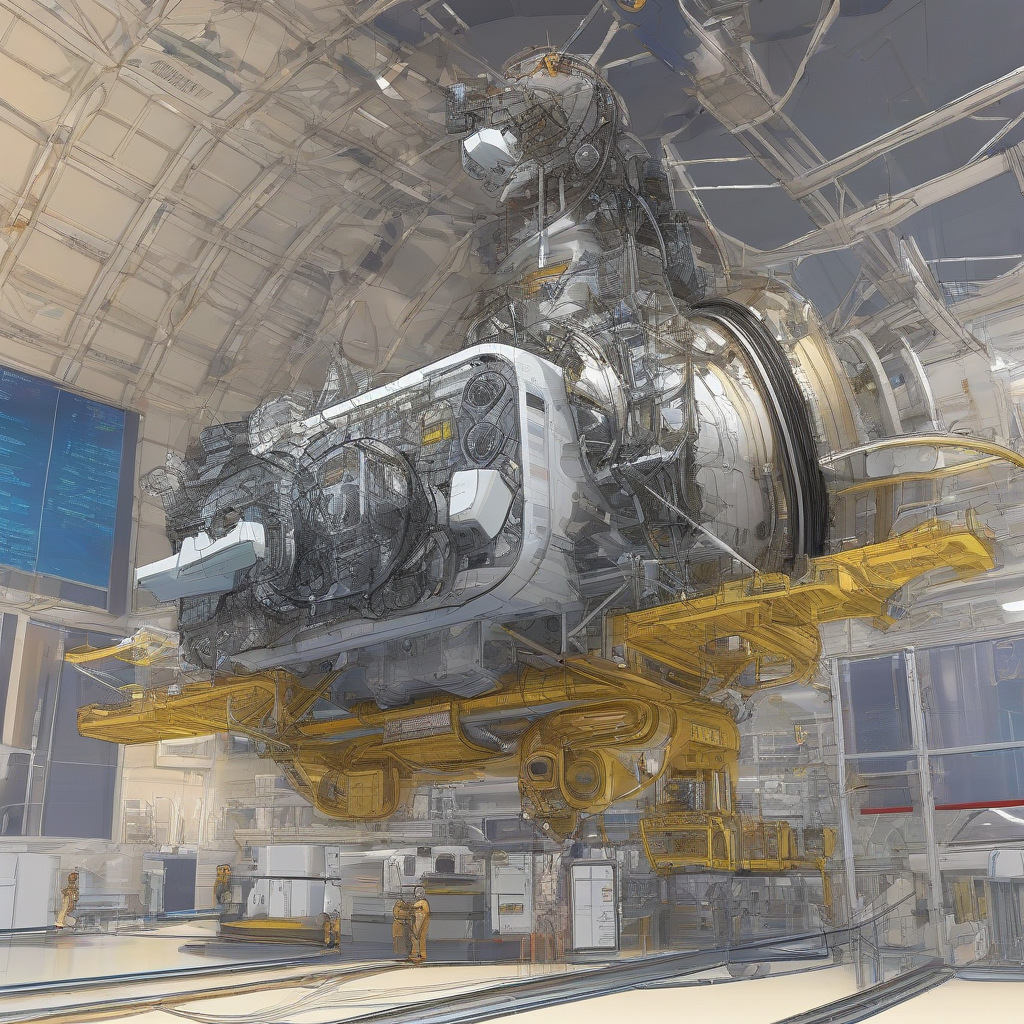
Artificial intelligence in manufacturing rocket parts
Revolutionizing Rocketry: How Artificial Intelligence is Transforming Manufacturing
In the world of space exploration, the European Space Agency (ESA) is at the forefront of innovation, pushing the boundaries of what is possible with cutting-edge technology. One area where the ESA is making significant strides is in the application of artificial intelligence (AI) to industrial manufacturing in space transportation. Three European Space Agency-supported projects are delivering clear advantages, and we take a closer look at how AI is transforming the manufacturing process.
Shot Peen Forming: Predicting Metal Deformation with Machine Learning
Shot peen forming is a process used to shape metal into complex forms without heating it. This technique is commonly used in the aerospace industry, where it is employed to shape the dome heads of rocket fuel tanks. However, the process is unpredictable, and each impact of the shot peen balls on the metal is unique. For the first time, machine learning is being used to predict how the metal will deform next, providing a fast and precise method to reach the desired shape with a tolerance of just two millimeters.
The ESA's Future Launchers Preparatory Programme (FLPP) is working with MT Aerospace in Germany to adapt material process techniques across the industry. By applying machine learning algorithms to the data collected from the shot peen forming process, the team is able to predict the deformation of the metal with high accuracy. This has significant implications for the manufacturing process, as it allows for faster and more precise shaping of metal components.
Friction Stir Welding: Automating the Welding Process with Machine Learning
Friction stir welding is a technique used to join metal components together by heating them with a rotating pin. This process is commonly used in the aerospace industry, where it is employed to join metal components together. However, the process can be time-consuming and requires significant manual intervention. The ESA's FLPP is working with MT Aerospace to automate the friction stir welding process using machine learning.
By applying machine learning algorithms to the data collected from the welding process, the team is able to automatically set up the machines, support documentation efforts, and check the shape of the final weld. This has reduced analysis time by 95% compared to the traditional process. The automation of the friction stir welding process has significant implications for the manufacturing process, as it allows for faster and more efficient production of metal components.
Automated Fibre Placement: Detecting Defects with Machine Learning
Carbon-fibre reinforced-plastic (CFRP) is a material used in the aerospace industry due to its high strength-to-weight ratio. However, the production of CFRP components can be complex and time-consuming. The ESA's FLPP is working with MT Aerospace and ArianeGroup to develop an automated fibre placement machine that uses machine learning to detect defects in the production process.
The machine uses laser sensors to detect and classify defects on the fly, which keeps production going and shortens production times significantly. The machine learning algorithms used in the system are able to detect defects in real-time, allowing for faster and more efficient production of CFRP components.
The Future of Manufacturing: How AI is Transforming the Industry
The application of AI to industrial manufacturing in space transportation is transforming the industry in significant ways. The use of machine learning algorithms to predict metal deformation, automate the welding process, and detect defects in the production process is allowing for faster and more efficient production of metal components.
The ESA's FLPP is at the forefront of this innovation, working with industry partners to develop and apply AI technologies to the manufacturing process. The implications of this technology are significant, as it has the potential to transform the manufacturing process and enable the production of complex components with high accuracy and precision.
Conclusion
The application of AI to industrial manufacturing in space transportation is a significant development in the field of aerospace engineering. The use of machine learning algorithms to predict metal deformation, automate the welding process, and detect defects in the production process is allowing for faster and more efficient production of metal components.
The ESA's FLPP is at the forefront of this innovation, working with industry partners to develop and apply AI technologies to the manufacturing process. The implications of this technology are significant, as it has the potential to transform the manufacturing process and enable the production of complex components with high accuracy and precision.
As the industry continues to evolve, it will be exciting to see how AI technologies are applied to the manufacturing process and what new innovations emerge. One thing is certain, however: the future of manufacturing is bright, and AI is leading the way.